

As products become more intelligent, connected, and adaptive, engineering is increasingly shaping how enterprises innovate, evolve, and create long-term value.
For years, product engineering was largely measured by delivery.
Could teams release faster? Could products reach the market sooner? Could development become more efficient?
Those questions still matter.
Yet many enterprises are beginning to encounter a different challenge.
Despite advances in cloud-native architectures, AI-assisted development, platform engineering, and modern delivery practices, sustaining product relevance is becoming increasingly difficult.
Building software has become easier.
Building products that remain valuable, adaptable, and differentiated over time has become significantly harder.
The reason is simple.
Products no longer operate in predictable environments. Customer expectations evolve continuously. New technologies emerge faster than traditional planning cycles can accommodate. Competitive advantages that once lasted years can now be replicated in months. Increasingly, products are expected to support future innovation rather than simply solve today’s problems.
This is quietly reshaping the role of product engineering.
What was once viewed primarily as a technology function is gradually becoming a business capability that influences innovation, adaptability, growth, and long-term enterprise value.
The Product Complexity Challenge
One of the most significant changes affecting modern product engineering is the growing complexity of digital products themselves.
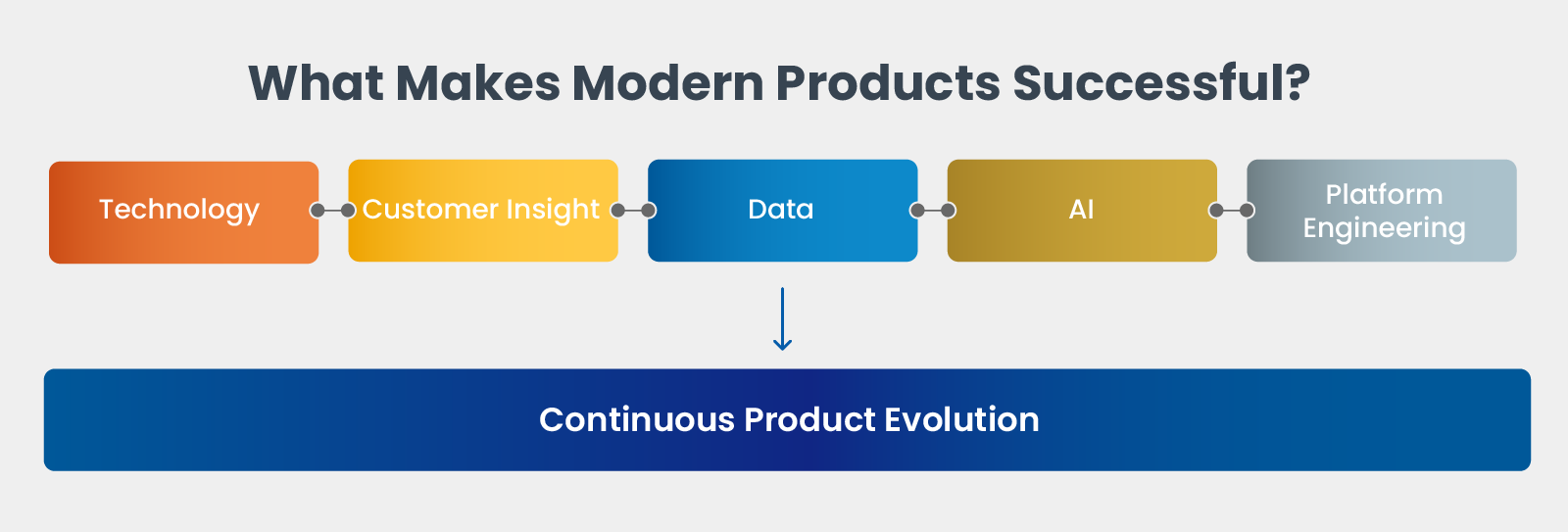
Products are no longer standalone applications supporting isolated business functions. A modern digital product may combine cloud-native infrastructure, APIs, data platforms, AI capabilities, partner integrations, observability frameworks, security controls, and customer experience layers into a single ecosystem.
As products become increasingly interconnected, engineering responsibilities expand beyond functionality.
Teams are no longer simply building features.
They are orchestrating digital ecosystems.
This shift changes the definition of product success. Scalability, maintainability, adaptability, and resilience become just as important as speed of delivery.
In many organizations, engineering decisions now directly influence how quickly products can respond to future customer expectations, technology shifts, and market opportunities.
That makes product engineering a strategic business concern rather than a purely technical one.
Why Some Products Scale While Others Stall
Many organizations successfully launch products.
Far fewer successfully evolve them.
This distinction is becoming increasingly important as technology cycles accelerate and customer expectations continue to rise.
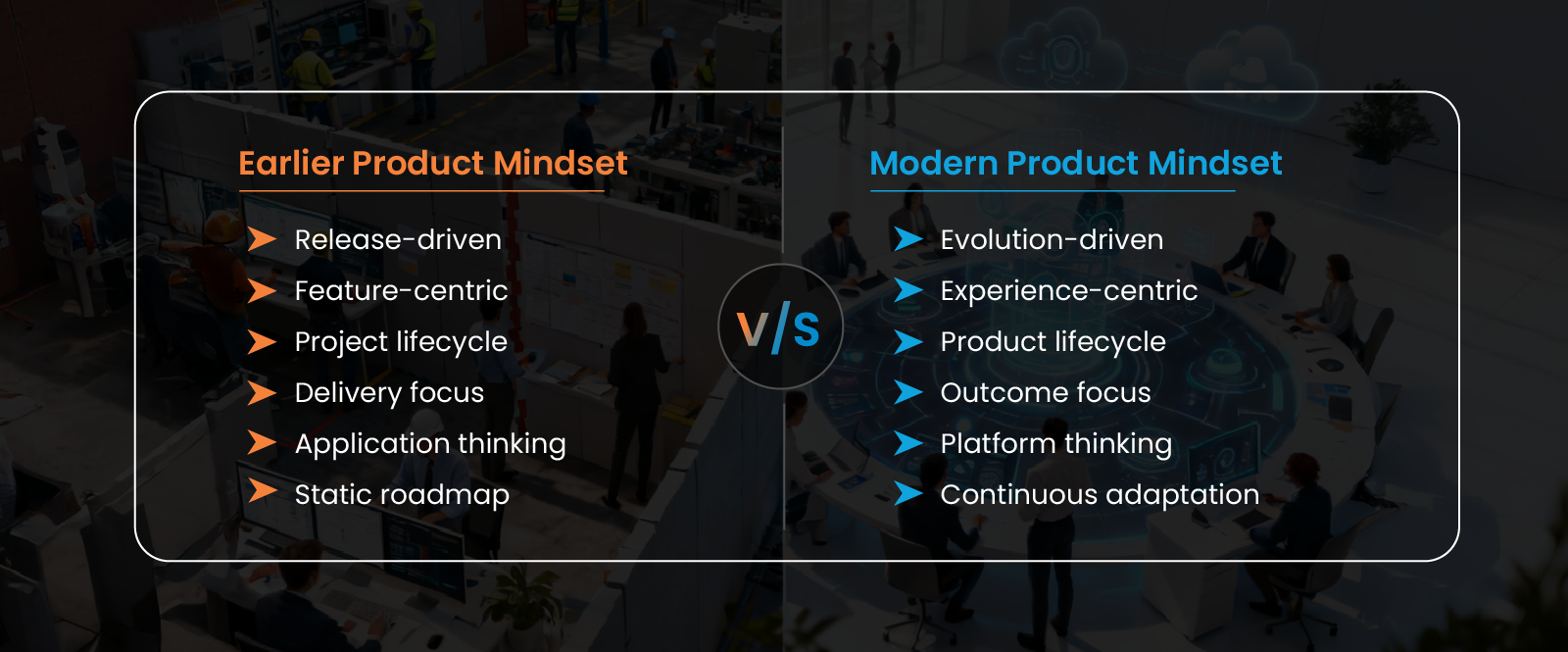
When product engineering is treated primarily as a delivery function, products are often optimized around releases, roadmaps, and feature completion.
When product engineering is treated as a business capability, products are optimized around customer outcomes, learning, adaptability, and long-term value creation.
The difference may appear subtle.
In practice, it can determine whether a product remains relevant five years from now.
Some products scale because they are designed to evolve.
Others stall because they are designed primarily to deliver.
As digital products increasingly become the primary interface between organizations and customers, adaptability may become one of the most important indicators of product success.
The Feature Velocity Trap
For years, engineering maturity was often associated with release frequency.
Faster releases were viewed as evidence of stronger engineering capabilities.
While speed remains important, many organizations are discovering that feature velocity alone does not necessarily create customer value.
Customers rarely remember how frequently features were released.
They remember whether products continue solving meaningful problems as their needs evolve.
This realization is shifting attention from delivery metrics toward adaptability metrics.
The most successful product organizations are often those capable of balancing execution speed with learning, customer feedback, product evolution, and strategic direction.
The question is gradually changing from:
“How quickly can we release?”
to
“How effectively can we evolve?”
That shift has profound implications for modern product engineering strategies.
The Hidden Cost of Adaptability Debt
For years, engineering leaders focused heavily on managing technical debt.
Today, many enterprises are beginning to encounter a different challenge.
Adaptability debt.
Adaptability debt emerges when products continue functioning successfully from a technical perspective but struggle to evolve as customer expectations, business priorities, and technology landscapes change.
Unlike technical debt, which often reveals itself through engineering inefficiencies, adaptability debt typically accumulates quietly.
Innovation becomes slower.
Product changes become more expensive.
Customer expectations become harder to meet.
Opportunities become more difficult to pursue.
Over time, adaptability debt can become a greater business constraint than technical debt itself.
Because products that cannot evolve eventually struggle to remain competitive.
This is one of the reasons modern enterprise product engineering increasingly focuses on designing systems that are adaptable by architecture rather than adaptable by exception.
Products are Becoming Business Platforms
One of the most important shifts occurring across enterprises today is that successful products increasingly evolve beyond their original purpose.
Historically, products were designed to solve a specific problem.
Today, successful digital products often become platforms capable of supporting new services, experiences, integrations, ecosystems, and revenue opportunities.
This changes the engineering mandate considerably.
Teams are no longer simply building for current requirements.
They are increasingly designing for future possibilities.
The question shifts from:
“What should we build?”
to
“What should this product be capable of becoming?”
That distinction represents a significant evolution in enterprise product thinking.
A practical example can be seen in Salesforce. What began as a CRM product evolved into a platform supporting a vast ecosystem of applications, integrations, industry solutions, and partner innovations. The product became far more valuable because it was able to extend beyond its original purpose.
Industry analysts at Gartner have consistently highlighted the growing importance of platform-centric approaches that enable organizations to accelerate innovation and create scalable digital ecosystems.
The most successful products increasingly create opportunities beyond their original use case.
And engineering plays a central role in making that possible.
The Most Valuable Products are Becoming Foundations for Future Possibilities
Historically, products were evaluated primarily by the value they delivered immediately after launch.
Leading organizations are beginning to evaluate products differently.
The question is no longer limited to what a product does today.
It increasingly includes what the product can enable tomorrow.
This is where product engineering begins moving closer to strategic business design.
Products become foundations for future opportunities, AI-enabled capabilities, ecosystem expansion, adjacent services, and entirely new business models.
Amazon provides one of the most cited examples of this principle. Infrastructure originally developed to support its retail operations eventually became the foundation for AWS. The lesson is not that every product becomes a billion-dollar platform. The lesson is that products designed with extensibility often create opportunities that are difficult to predict when the original product is first conceived.
In this environment, engineering is no longer focused solely on delivering current functionality.
It is increasingly focused on creating products that can adapt, extend, and evolve as new opportunities emerge.
Because the most valuable products often generate possibilities that were not fully visible when the original product was first designed.
The Shelf-Life of Competitive Advantage is Shrinking
Historically, organizations could launch a successful digital product and maintain a meaningful advantage for years.
Today, competitive advantages are becoming increasingly temporary.
Technology becomes accessible faster.
Capabilities become easier to replicate.
Customer expectations continue to evolve.
As a result, sustainable advantage increasingly depends on an organization’s ability to evolve products faster than competitors can imitate them.
This fundamentally changes the role of product engineering.
Engineering is no longer simply responsible for building products.
It becomes responsible for sustaining relevance.
Research and insights published by McKinsey & Company consistently point toward organizational adaptability as one of the defining capabilities required to navigate increasingly dynamic markets.
The organizations that adapt continuously often create advantages that are far more durable than individual product features.
AI is Changing Product Engineering Itself
Much of the discussion around AI focuses on AI-powered products.
An equally important conversation is how AI is transforming the process of product engineering itself.
AI is increasingly influencing product discovery, software development, quality engineering, user experience optimization, observability, customer feedback analysis, and operational decision-making.
This creates shorter learning cycles and enables organizations to iterate more intelligently.
At the same time, it introduces new considerations around governance, reliability, trust, scalability, and engineering effectiveness.
Organizations are moving beyond simply embedding AI into products.
They are beginning to rethink how products are designed, built, tested, and evolved in AI-enabled environments.
This may become one of the most significant shifts shaping the future of enterprise product engineering.
Product Engineering is Quietly Becoming a Growth Function
Historically, product engineering and business growth were often viewed as separate organizational responsibilities.
One focused on building products.
The other focused on expanding markets.
That distinction is becoming increasingly blurred.
As products become more intelligent, data-driven, and continuously evolving, engineering decisions increasingly influence customer retention, expansion opportunities, platform adoption, ecosystem growth, and long-term differentiation.
This elevates product engineering beyond delivery.
It becomes a contributor to growth.
And that may be one of the most important organizational shifts occurring inside modern enterprises.
Engineering is Increasingly Defining Business Strategy
Historically, business strategy informed engineering decisions.
Increasingly, engineering capabilities are influencing what business strategies become possible.
When digital products, AI capabilities, APIs, data ecosystems, and platforms become primary drivers of growth, engineering choices begin shaping future market opportunities, customer experiences, operational models, and revenue streams.
This is one of the reasons product engineering is moving closer to boardroom conversations across modern enterprises.
Organizations such as ServiceNow and Atlassian have demonstrated how platform-centric engineering can create ecosystems that continuously expand value beyond the initial product experience.
Because engineering is no longer simply supporting the business.
It is increasingly influencing what the business can become.
Bringing It All Together
Modern product engineering is no longer simply about developing software.
It is becoming a strategic capability that enables organizations to innovate, adapt, and create sustained business value.
As products become increasingly connected, intelligent, and ecosystem-driven, the ability to continuously evolve may become one of the most important competitive differentiators organizations can build.
The enterprises that lead the next decade may not necessarily be those that launch the most products.
They may be the organizations that create engineering environments capable of continuously generating new products, experiences, and business opportunities as markets evolve.
Because in increasingly digital enterprises, engineering is no longer simply supporting the business.
It is increasingly shaping what the business can become.
NewVision’s Perspective
At NewVision, we believe modern product engineering is increasingly becoming the discipline of creating products that can continuously adapt, extend, and evolve as new opportunities emerge.
As products become more intelligent, connected, AI-enabled, and ecosystem-driven, engineering decisions are no longer limited to current requirements alone. They increasingly influence how effectively organizations can respond to future customer expectations, technology shifts, business models, and market opportunities.
Because the next generation of enterprise value may not come from products designed only for today’s needs.
It may come from products intentionally engineered to continuously create new possibilities over time.
And in that environment, product engineering becomes far more than a technology function.
It becomes a strategic capability that helps define how enterprises evolve.