
Digital transformation is rapidly moving into its next phase: from purely digital to truly intelligent as we approach 2026.
Enterprises across industries are shifting from automation and analytics to AI-enabled digital transformation. It is no longer about replacing manual processes but enabling systems that can learn, adapt, and make decisions autonomously. The second wave of transformation will be marked by AI tools transforming businesses, scaling faster, operating smarter, and competing in an intelligence-driven world.
From Digital to Intelligent Transformation
Until recently, digital transformation had focused on speed, modernization, and process efficiency. But as AI is maturing, businesses are releasing efficiency is just the beginning.
The true value of the AI transformation tools lies in their ability to deeply understand patterns, prediction, and continuous improvement of business performance. Imagine operations optimizing themselves, customer platforms personalizing in real time, and software that is capable of self-healing even before issue arises.
This is the new enterprise reality: where digital maturity finally evolves into intelligent adaptability. We’re observing a fundamental shift:
- From Automation to AI-driven Autonomy
- From static dashboards to predictive decision intelligence
- From digital initiatives to AI-first operating models
Businesses that make this shift early will see not only a boost in productivity but also a redefinition of how value is created.
The State of AI-Driven Digital Transformation in 2025
Recent reports reveal just how AI is transforming businesses and how rapidly organizations are leveraging AI transformation tools worldwide:
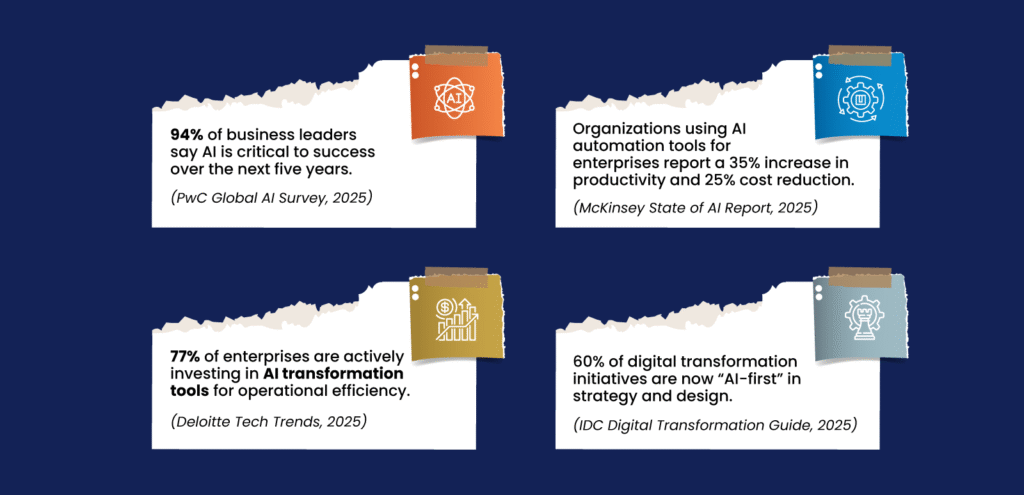
These numbers indicate that AI’s influence goes far beyond IT in redefining how the enterprises operate, serve, and innovate.
The Core AI Stack Powering Transformation in 2026
The best AI tools for business now work in unified way-connecting data, people, and decisions to build smarter ecosystems.
AI for Data and Analytics
Data is evolving from a resource into a strategic intelligence layer. Beyond Microsoft Fabric, Databricks AI, and Snowflake Cortex, enterprises are now adopting:
- Google Vertex AI for scalable model training, automated prompts, and advanced vector search
- AWS Bedrock for industry-ready foundation models with secure enterprise integration
- Qlik Talend for AI-driven data quality, lineage, and governance
- ThoughtSpot Sage for conversational analytics that democratize insights
- Alation Copilot for metadata intelligence and automated data discovery
What this means for the business:
- 30 to 50 percent faster decision cycles through auto-insights
- Improved data trust and governance for compliance-heavy industries
- Lower operational costs by removing data silos and manual reporting
- Predictive analytics that proactively identify opportunities and risks
AI for Software Development
The development lifecycle is shifting from writing code to guiding AI systems that generate, refactor, and optimize code. Alongside GitHub Copilot and AWS CodeWhisperer, enterprises are now exploring a broader stack of engineering copilots and platforms that accelerate end-to-end development.
- Google AntiGravity for AI-assisted design, architecture exploration, and automated refactoring
- Codeium Enterprise for private, secure, model-backed code generation
- Tabnine Enterprise for policy-controlled AI coding in regulated environments
- Replit AI for rapid prototyping, scaffolding, and developer workflow automation
- Sourcegraph Cody Enterprise for codebase-level search, understanding, and guided improvement
What this means for the business:
- 40 to 60 percent faster development through AI-led coding
- Reduced technical debt via automated refactoring and architecture suggestions
- Stronger security by integrating AI-driven code reviews and vulnerability detection
- Higher developer productivity with AI copilots augmenting everyday workflows
AI in Software Testing
Testing is evolving into an intelligent, autonomous function powered by AI. Instead of catching defects late, AI predicts failures, prioritizes tests, and maintains test assets automatically. Beyond Tricentis Tosca AI and GitHub Copilot for Test, enterprises are adopting:
• Testim and Mabl for autonomous end to end testing
• Applitools Visual AI for intelligent UI validation and self healing tests
• Launchable for AI driven test prioritization using machine learning signals
• Functionize for autonomous test creation and maintenance
• AccelQ AI for zero touch test automation across web, mobile, and API
What this means for the business:
• 40 to 60 percent reduction in QA effort
• Self healing test assets that reduce maintenance overhead
• Faster release cycles without compromising stability
• Lower risk of production outages
• Predictive identification of fragile components and high risk test cases
AI for Process Automation
RPA is now evolving into generative and agentic automation. Beyond UiPath Autopilot and Power Automate with Copilot, enterprises are now embracing:
- Automation Anywhere Autopilot for generative document automation
- ai for intelligent conversational workflows
- Cognigy and Amelia for enterprise-grade AI service agents
- SAP Joule for automated finance, procurement, and supply chain tasks
- Workato AI for auto-building integrations and workflows
What this means for the business:
- 45 percent reduction in manual workflows
- Real-time, self-learning processes that adjust without intervention
- Faster cycle time across procurement, finance, HR, and operations
- Lower dependency on human orchestration, improving scalability
AI for Experience and Engagement
Personalization has matured into real-time intent prediction. Beyond Adobe Firefly and Jasper, more advanced tools are emerging:
- Persado for behavioral AI-driven communication
- Canva Enterprise with GenAI for brand-consistent content and design
- Salesforce Einstein Copilot for hyper-personalized CRM experiences
- Drift and Intercom Fin AI for AI-led customer conversations
- Sprinklr AI Studio for sentiment prediction and customer journey insights
What this means for the business:
- Increase in conversion rates by 20 to 40 percent
- Human-like conversational engagement across channels
- Dramatically faster content creation with brand consistency
- Improved customer retention through predictive personalization
AI for IT and Cloud Operations
IT is moving toward autonomous systems that self-monitor, self-recover, and optimize. In addition to Dynatrace, Azure Automanage, and ServiceNow AI, enterprises are also adopting:
- Splunk AI Assistant for real-time operational investigation
- New Relic Grok for natural-language observability
- Datadog Bits AI for anomaly detection across microservices
- PagerDuty AI for incident prediction and automated runbooks
- Cisco ThousandEyes AI for global network performance intelligence
What this means for the business:
- Up to 70 percent fewer critical incidents
- Predictive maintenance replacing reactive firefighting
- Faster response to outages with AI-generated resolutions
- Better uptime stability for customer-facing platforms
Top Areas Where AI is Transforming Businesses
According to the Gartner AI Business Impact Report (2025):
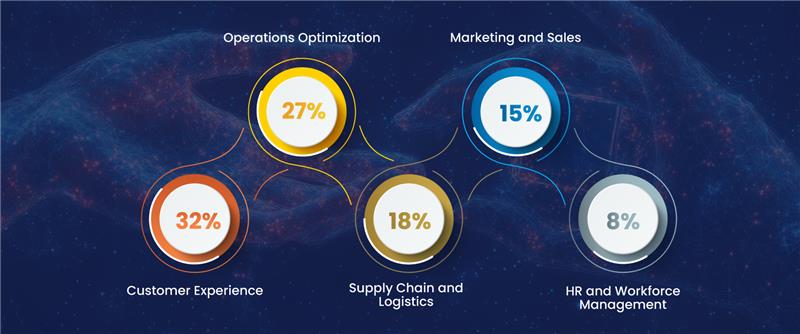
These insights highlight on how AI is no longer confined to IT or analytics teams; instead, its impact goes across customer-facing, operational, and strategic layers in terms of transforming how organizations function end to end.
Why Tools Alone Aren’t Enough
Most enterprises begin their AI journey with excitement, adopting new tools, experimenting with pilots, and automating quick wins. But the real challenge appears when they try to scale these efforts across the organization.
This is a point where superficial digital transformation narratives usually end, but true industry leaders recognize a deeper reality.
AI tools help accelerate transformation, but it is the underlying AI foundations that actually make transformation possible.
Without strong data architecture, governance, security, and operating models, even the best of tools fails to deliver consistent, enterprise-level outcomes.
Now, let’s check out what really determines AI success at scale, including the structures, disciplines, and guardrails that turn isolated pilots into sustainable, organization-wide intelligence.
Challenges in AI-Driven Transformation
Data readiness gaps: Most organizations still deal with fragmented data and inconsistent quality, limiting the accuracy and reliability of AI models.
Governance and explainability: As AI decisions become part of critical workflows, enterprises must ensure models are transparent, traceable, and audit-ready.
Skill shortages: AI product owners, model-risk specialists, and data governance roles are still in short supply, slowing execution.
Legacy systems: Older architectures are not designed for real-time intelligence, making integration expensive and complex.
Model cost and performance: Without FinOps practices, compute-heavy models lead to unpredictable cloud bills and inefficiencies.
These challenges underscore the need for strong foundations before scaling AI across the business
Industry Micro Use Cases: How AI Is Creating Real Impact
AI is no longer theoretical; it’s already driving measurable outcomes across industries. A few examples include:
BFSI – Automated KYC verification, anomaly detection in transactions, and AI-driven credit risk scoring are speeding up compliance and reducing fraud.
Retail – AI engines now power dynamic pricing, demand forecasting, and real-time personalization based on intent, not just historical behavior.
Healthcare – Clinicians benefit from AI-generated documentation, faster diagnostics support, and automated claims processing that cuts administrative load.
Manufacturing – Predictive maintenance reduces downtime, while computer vision supports quality control and supply chain optimization.
Telecom – AI predicts network outages, enhances bandwidth allocation, and improves customer support through conversational agents.
These micro use cases demonstrate how AI is reshaping everyday operations across sectors.
AI Operating Models for 2026
As AI becomes enterprise-wide, organizations are rethinking how they structure teams and workflows:
AI platform teams
Central groups that manage data products, model lifecycle, and reusable AI components across the company.
Federated governance
Business units innovate independently, but within shared guardrails that ensure responsible, compliant AI.
Copilot-first workflows
Teams in finance, HR, supply chain, marketing, and engineering use AI copilots to automate day-to-day decision-making.
Business-led AI adoption
Instead of technology-first experiments, enterprises define outcomes and then design the AI solutions backward from KPIs.
These models help enterprises scale AI consistently while keeping innovation decentralized.
AI Security, Privacy, and the Enterprise Trust Layer
As AI becomes embedded in core systems, trust becomes a strategic priority. Enterprises are strengthening:
Model security: Controlling who can access models, datasets, and prompts, ensuring safe deployment.
Data privacy: Using anonymization, tokenization, and synthetic data to protect sensitive information throughout the AI lifecycle.
Continuous monitoring: Tracking bias, drift, and model degradation to maintain accuracy over time.
Regulatory readiness: Adapting to frameworks like the EU AI Act and emerging global guidelines for responsible AI.
These safeguards ensure AI remains secure, compliant, and enterprise-ready at scale.
What’s Next: Trends That Will Shape 2026
AI is evolving from task automation to enterprise-wide intelligence. Some defining trends include:
Responsible AI governance: No longer optional; enterprises are formalizing guidelines for bias, security, and explainability.
Multimodal AI: Models that understand text, image, video, audio, and behavioral data are unlocking richer business insights.
Domain-specific small models: Instead of relying only on large general models, enterprises prefer compact, domain-tuned models that are cheaper, faster, and more accurate.
Copilots everywhere: Every department, from finance to logistics to engineering, is adopting copilots that augment teams with context-aware decision support.
These trends signal a shift from improving workflows to redesigning entire business models.
Organizations that succeed in 2026 will:
- Invest in unified data architectures ahead of AI adoption.
- Prioritize explainable and auditable AI
- Incorporate human judgment in AI decision cycles.
- Measure transformation not just in efficiency, but in strategic intelligence gained.
The NewVision Perspective
At NewVision, AI-driven digital transformation is all about the journey from automation to intelligence. Through our SmartVision framework, we help enterprises create AI-powered ecosystems that connect strategy, technology, and data, enabling measurable outcomes across engineering, analytics, and operations.
Our approach emphasizes:
- Data discipline before AI adoption
- Responsible and explainable AI
- AI assurance for accurate, secure, and reliable deployments
- Outcome-first transformation aligned with business KPIs
In our view, transformation isn’t just deploying AI but ensuring intelligence based faster business results
Final Thought
The best AI tools for business in 2026 will make companies not only faster; but smarter in a true sense. Those who treat AI as a co-strategist, rather than just capability, will lead the next era of digital transformation built on intelligence, adaptability, and trust.