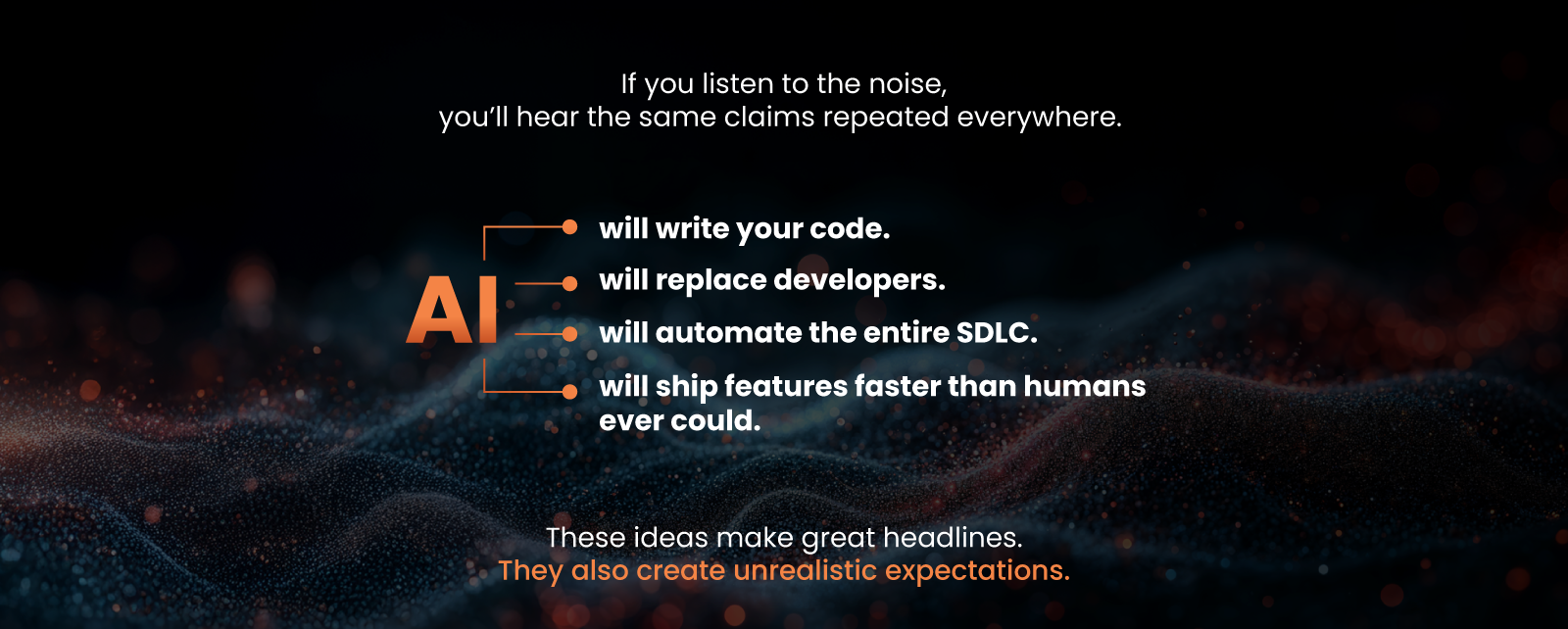
Inside real engineering environments, something very different is happening. AI in software development is not replacing developers, it is reshaping how engineering, product, design, and architecture collaborate. It is not removing complexity, it is exposing technical, product, and architectural debt that teams have ignored for years. AI is not a shortcut. AI is an amplifier. When your systems are strong, AI accelerates them. When they are weak, it breaks them faster.
The industry conversation today is dominated by hype, fear, and oversimplified takes. This is the reality engineering leaders must now respond to.
AI is Not Replacing Developers. It is Replacing Waste.
Every engineering team deals with two layers of work, the work that creates value and the work that quietly drains productivity.
The Real Bottleneck in Software Development Has Never Been Coding
Leaders have long equated development speed with coding speed. Yet every engineering assessment tells the same story: the bottleneck has never been typing speed.
Bottlenecks emerge upstream in product and requirements, across UX and architecture, and downstream in testing and operations. Unclear product intent, misaligned stakeholders, architectural debt, lack of acceptance criteria, slow QA cycles, fragile environments, and communication breakdowns cause rework — the single most expensive activity in modern software development.
Research from McKinsey 2025 shows that 40–60% of engineering effort is spent on rework caused by unclear requirements, architectural debt, and fragmented communication. AI magnifies this dynamic. When clarity is weak, AI accelerates chaos. When architecture is shaky, AI builds on the wrong foundation. When domain intent is vague, AI generates technically correct but strategically useless code. AI does not remove bottlenecks; it forces teams to confront them.
Example: A global insurer using AI-assisted requirements analysis identified conflicting acceptance criteria across three teams. By surfacing these early, AI prevented two weeks of rework in the sprint cycle.
AI does not remove bottlenecks. It forces teams to confront them.
AI Is Shifting Teams from Code-First to Product-First
For decades, teams optimized around code, code reviews, coding standards, coding KPIs. But in an AI-driven environment, the center of gravity shifts from code to intent.
Teams that succeed with AI are the ones that define problems clearly. They articulate constraints, business rules, UX flows, architecture boundaries, and quality expectations with precision. AI thrives when product intent is well formed. It fails when intent is incomplete.
A retailer tested scenarios with two different product teams.
Team A: Provided vague requirements to the AI, which produced scaffolding quickly, but the misalignment caused confusion and rework.
Team B: Spent three hours clarifying requirements by refining UX flows, acceptance criteria, and architecture assumptions. This allowed the AI to generate code, tests, and documentation within minutes, dramatically compressing the development cycle.
“Same tool. Different clarity.
Massive difference in outcomes.”
According to PwC 2024, 94% of business leaders believe AI will be critical to software development success in the next five years, but success depends on integrating AI with process clarity, not just tooling.
AI Coding Tools Are Overrated. AI Systems Are Underrated.
Most conversations about artificial intelligence software development stop at coding copilots. But the real transformation is happening deeper; inside architecture, QA, observability, integration, and operations.
Example: Healthcare platforms now use AI anomaly detection to flag integration failures before production, reducing costly downtime. Manufacturing companies leverage AI-driven edge systems to adapt machine behavior in real time, saving 20–30% in operational inefficiencies.
“AI that writes code is incremental.
AI that shapes systems is transformative.”
The future belongs to teams who build AI-led systems, not teams who merely use AI tools.
AI-Assisted Engineering Is a Step. AI-Native Engineering Is the Destination.
Most companies today are stuck in the AI-assisted stage, developers using copilots, QA auto generating test cases, product writing faster documentation.
Useful, but not transformational.
AI-native engineering looks radically different. Requirements become executable intent. Architecture evolves continuously. Testing becomes predictive. Deployments evaluate themselves. Systems adapt based on real-time data. Documentation becomes a living knowledge graph that updates itself.
| AI-ASSISTED ENGINEERING
(Teams using AI tools but keeping the same old workflows) |
AI-NATIVE ENGINEERING
(Teams redesigning the SDLC so AI shapes every stage of product development) |
| 1. Purpose of AI | 1. Purpose of AI |
| Speed up developer tasks | Clarify intent |
| Generate code, tests, documentation | Optimize architecture |
| Act as a productivity booster | Predict quality issues |
| Limited to individual contributors | Automate discovery → design → dev → QA → ops |
| Embedded into the engineering operating system | |
| 2. Role of Humans | 2. Role of Humans |
| Still responsible for translating vague requirements | Make strategic decisions |
| Manual decision-making across architecture | Validate architectural patterns |
| QA discovers issues late | Apply domain expertise |
| Ops handles incidents reactively | Drive complex problem-solving, not mechanical work |
| 3. Workflows | 3. Workflows |
| Linear, handoff-heavy SDLC | Continuous, closed-loop SDLC |
| Requirements → Design → Dev → QA → Ops | AI-operated feedback cycles across all stages |
| AI plugged into individual stages only | Reduced handoffs |
| Still dependent on human-driven velocity | Requirements become executable intent |
| Designers, architects, and engineers collaborate simultaneously | |
| 4. Code & Architecture | 4. Code & Architecture |
| AI helps write code, but architecture remains manual | Architecture is AI-assisted and continuously validated |
| Patterns inconsistent | Boundaries, flows, integrations auto-checked |
| Boundaries unclear | Technical debt identified early |
| High rework due to upstream ambiguity | Code scaffolding, modules, tests, and docs generated in sync |
| 5. Testing & Quality | 5. Testing & Quality |
| AI writes unit tests but cannot validate intent | Predictive quality |
| QA still reactive | Property-based testing, test data generation, scenario modeling |
| Regression remains slow | Regression scanning on every change |
| Test coverage inconsistent | Quality shifts left and becomes continuous |
| 6. Delivery Speed | 6. Delivery Speed |
| Moderate improvement (10–20%) | Dramatic improvement (30–70%) |
| Gains flattened over time | Rework collapses |
| Bottlenecks remain in discovery, design, environments | Complexity becomes manageable |
| Teams focus on value, not glue work | |
| 7. Outcome | 7. Outcome |
| Faster coding, but same systemic problems | Consistent, predictable engineering |
| Efficiency without predictability | Higher-quality software |
| Low sustainable velocity | Faster cycles + fewer failures + stronger user outcomes |
| Sustainable velocity | |
|
Scalable engineering culture |
“This is not speed improvement.
This is reinvention.”
Leaders Must Rebuild their Operating Models, Not Just Adopt AI
The common failure pattern is simple, companies add AI tools but keep legacy processes. They keep the same sprints, rituals, handoffs, and governance. AI gives little value to teams that refuse to change how they operate.
Leaders must rethink roles, workflows, team structures, feedback loops, and success metrics. The goal is not more developers using AI. The goal is eliminating unnecessary work, reducing rework loops, elevating architecture discipline, and focusing human energy on decision-making rather than mechanical activity.
The AI-Accelerated SDLC: A Blueprint for How Modern Engineering Actually Works
AI is not removing the SDLC. It is compressing it into a continuous, intelligent loop where every stage strengthens the next. High-velocity engineering organizations, including DPS, are already practicing a new AI-native lifecycle. AI compresses the SDLC into a continuous, intelligent loop where every stage strengthens the next. High-velocity organizations using a modern Digital Product Studio model have initiated the shift toward this AI-native SDLC. It elevates engineers by removing repetitive overhead and amplifying focus on value work.
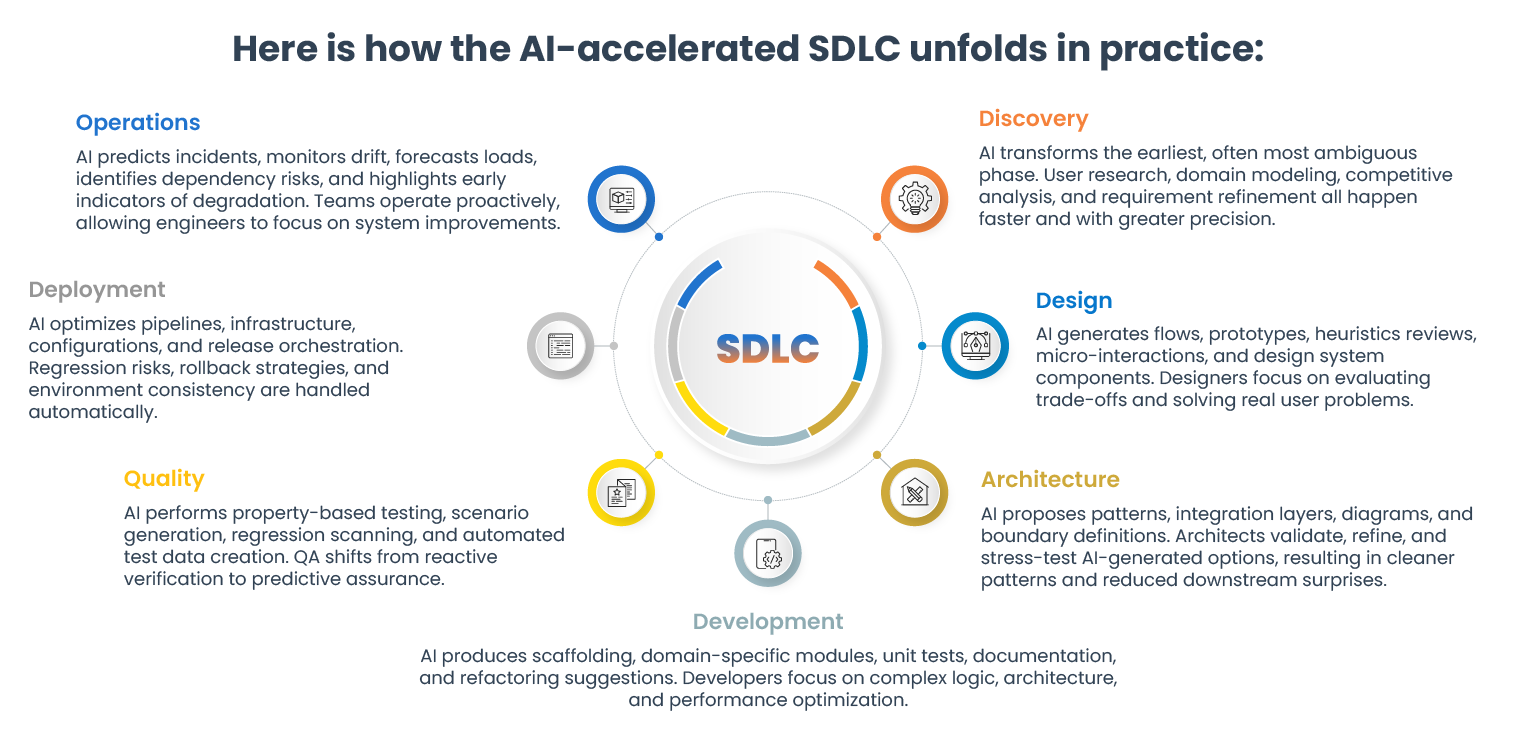
“The SDLC is no longer a sequence of handoffs.
It is a continuous, AI-reinforced loop.”
Leader Playbook: How to Build an AI-Ready Engineering Org
If you are an engineering leader preparing your teams for an AI-native future, focus on these foundations:
- Strengthen clarity: AI thrives on well-formed intent. Align product, design, and engineering around unambiguous context.
- De-risk architecture: Remove hidden complexity, standardize patterns, and create stable boundaries so AI can operate reliably.
- Redesign workflows: Reduce handoffs, shorten feedback loops, and empower teams to work with AI continuously rather than episodically.
- Treat AI as a capability, not a tool: Integrate AI into platforms, pipelines, and architecture — don’t limit it to developer productivity.
- Invest in domain knowledge: AI amplifies domain clarity. Teams who deeply understand the problem space will always outperform teams who don’t.
The companies that implement these foundations are already seeing 30 to 70 percent faster delivery, not because AI is writing code for them, but because AI is removing everything that used to slow them down.
Final Thought: AI Does Not Build Great Products. People Who Know How to Use AI Do
AI does not understand strategy, user frustration, or trade-offs. Teams that know how to use AI, clarify intent, simplify systems, eliminate waste, and architect intelligently will outperform everyone else.
AI is redefining how modern engineering operates and how high-performing teams deliver software at scale.
NewVision’s Point of View
NewVision approaches AI in software development with a simple principle. AI only accelerates what you are structurally ready to scale. This is why our SmartVision framework is built around four engineering pillars:
- Product Clarity Acceleration: AI-enhanced requirement modeling, ambiguity detection, scenario generation, and domain mapping
- Architecture Intelligence: automated pattern validation, boundary enforcement, dependency analysis, and scalability simulation
- AI-Native Quality Engineering: continuous risk prediction, property-based testing, synthetic data generation, and regression scanning
- AI-Augmented Delivery: intelligent pipelines, environment automation, drift detection, deployment risk scoring, and observability insights
With this approach, we help organizations move from isolated AI tools to true AI-native engineering. Requirements become executable intent. Architecture stays stable. Quality becomes predictive. Delivery becomes consistent. Teams operate with clarity, not guesswork.
Our customers see faster releases, fewer defects, stronger architecture, and higher product confidence. These outcomes do not come from AI replacing developers. They come from removing everything that holds developers back.
At NewVision, AI is the foundation for the next generation of engineering.