
How enterprise leaders are rethinking automation in an AI-first world
A few years ago, the automation conversation was relatively straightforward.
Organizations identified repetitive tasks, deployed bots, reduced manual effort, and measured success through efficiency gains. For many businesses, Robotic Process Automation (RPA) delivered exactly what it promised.
Today, the conversation looks very different.
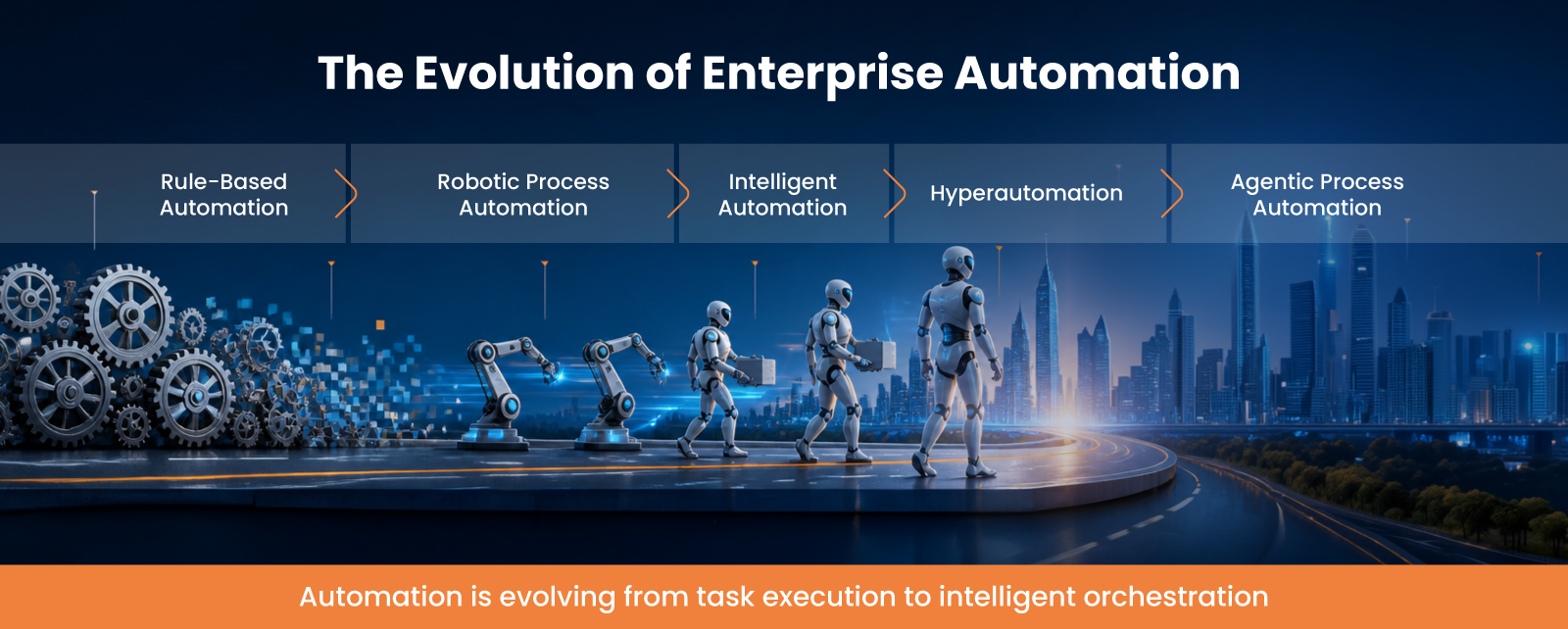
Enterprise leaders are evaluating AI copilots, intelligent workflows, process intelligence, and emerging agentic systems. Automation is no longer limited to executing tasks. Increasingly, it is helping organizations improve how decisions, information, and work flow across the business.
This shift raises an important question:
Is Robotic Process Automation still worth it?
The answer is yes.
However, the role of RPA is evolving.
Many assumptions that shaped automation strategies over the last decade are being challenged by changing business priorities, AI adoption, and higher expectations around business outcomes. Organizations are no longer asking how many tasks can be automated. They are asking how automation can improve agility, accelerate decision-making, and support enterprise-wide transformation.
That is why many common RPA Myths deserve a second look.
What Has Changed About Automation?
One of the biggest misconceptions about RPA Technology is that its value begins and ends with automating repetitive tasks.
Historically, that perception made sense. Early automation initiatives focused on data entry, invoice processing, report generation, and system reconciliation.
Today, leading organizations are taking a broader view.
The objective is no longer to automate a single task. The objective is to improve how an entire process operates. Customer onboarding, claims processing, service management, and software delivery all benefit when information, decisions, and workflows move more efficiently across the business.
This is where organizations increasingly combine Intelligent Automation, workflow orchestration, analytics, and automation capabilities to create stronger business outcomes.
As organizations mature their automation initiatives, the focus increasingly shifts from automating individual tasks to orchestrating entire business processes. This aligns with Gartner’s view that hyperautomation combines automation, process intelligence, and orchestration to improve business outcomes at scale.
Source: Gartner – What Is Hyperautomation?
Why Bot Count is Becoming a Less Meaningful Metric
For years, automation success was measured through metrics such as bots deployed, processes automated, and hours saved.
Those metrics still matter.
But they no longer tell the full story.
Leading organizations increasingly focus on business outcomes:
- Did customer onboarding become faster?
- Did operational bottlenecks decrease?
- Did decision-making improve?
- Did employee productivity increase?
- Did customer experiences improve?
The conversation is shifting from:
“How much work did we automate?”
to
“What business outcome did we improve?”
This evolution is changing how organizations evaluate Business Process Automation, RPA Automation, and modern RPA Solutions.
Increasingly, automation is becoming a business agility conversation rather than an efficiency conversation.
Organizations that remove friction from customer journeys, employee experiences, and operational workflows often create far greater value than those focused solely on reducing manual effort.
For organizations evaluating transformation initiatives, measurable outcomes often become visible through real-world automation success stories and enterprise transformation case studies.
The Hidden Barrier to Automation Success
When automation initiatives struggle, technology is often blamed.
In reality, many challenges emerge long before technology enters the picture.
One of the most overlooked barriers is process debt.
Over time, business processes accumulate manual workarounds, exceptions, duplicate approvals, fragmented ownership, and unnecessary complexity. Organizations then attempt to automate those processes exactly as they exist.
The result is predictable.
Complex processes create complex automation.
This remains one of the biggest challenges in successful RPA Implementation programs.
Many automation programs also depend on strong process quality, validation frameworks, and governance models. This is where disciplines such as Digital Assurance increasingly support enterprise automation initiatives.
Microsoft’s Work Trend Index highlights a growing need for organizations to simplify how work moves across teams, systems, and information sources. The opportunity is not simply to automate more work, but to create more effective ways of working.
Source: Microsoft – Work Trend Index
Before asking:
“Can this process be automated?”
Enterprise leaders should ask:
“Should this process remain the same before we automate it?”
That single question often determines whether automation scales successfully.
Why RPA and AI Work Better Together
Many organizations still view automation and AI as separate initiatives.
The market is moving in a different direction.
Increasingly, organizations are combining RPA, AI, analytics, document intelligence, and workflow orchestration to create AI-Powered Automation capabilities.
This convergence is driving the growth of Intelligent Automation, where technologies work together to improve process execution, decision support, and operational efficiency.
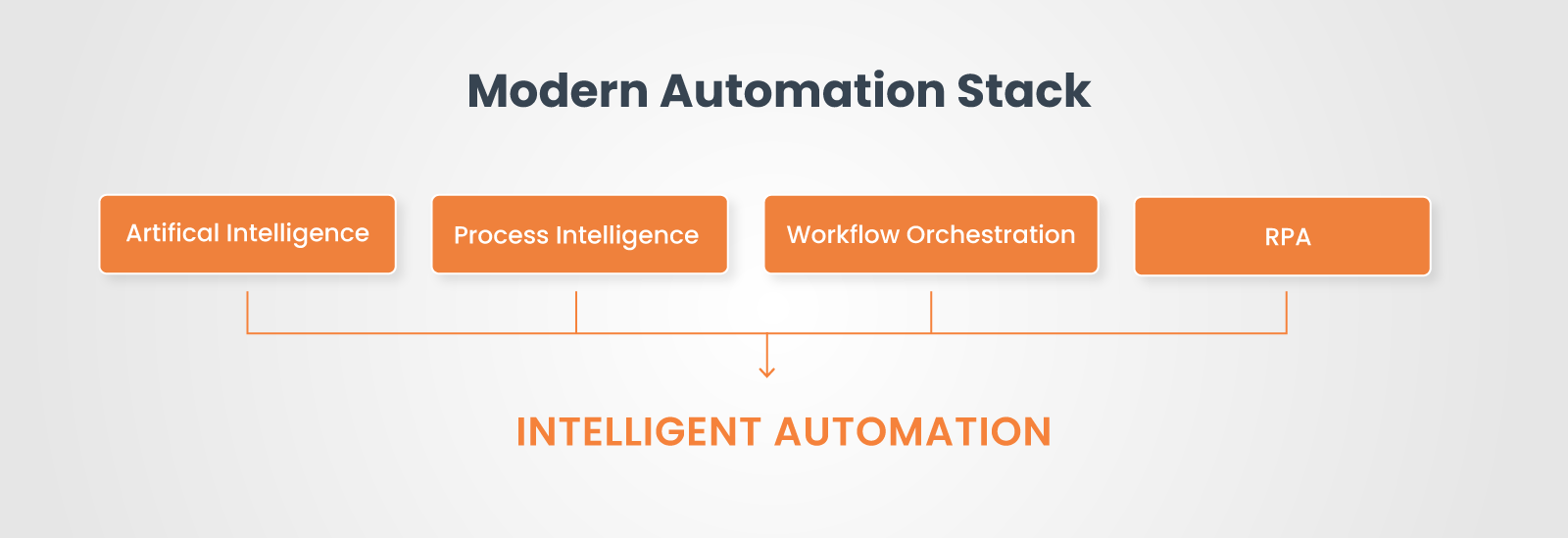
The convergence of AI and automation is becoming one of the most significant shifts in the market. UiPath’s automation research highlights how organizations are increasingly combining AI, automation, and orchestration to create more adaptive and intelligent operations rather than treating them as separate initiatives.
Source: UiPath – Automation Trends and Industry Insights
For organizations investing in Enterprise AI, Data Analytics & AI, and broader transformation initiatives, automation increasingly becomes a foundational capability rather than a standalone project.
Organizations evaluating AI-powered automation should also assess their AI Readiness across data, governance, operating models, and business processes.
What the Future Looks Like
The future of automation is not RPA versus AI.
It is RPA working alongside AI, analytics, orchestration, and emerging technologies.
This is where concepts such as Hyper automation, Enterprise Automation, and Agentic Process Automation are gaining momentum.
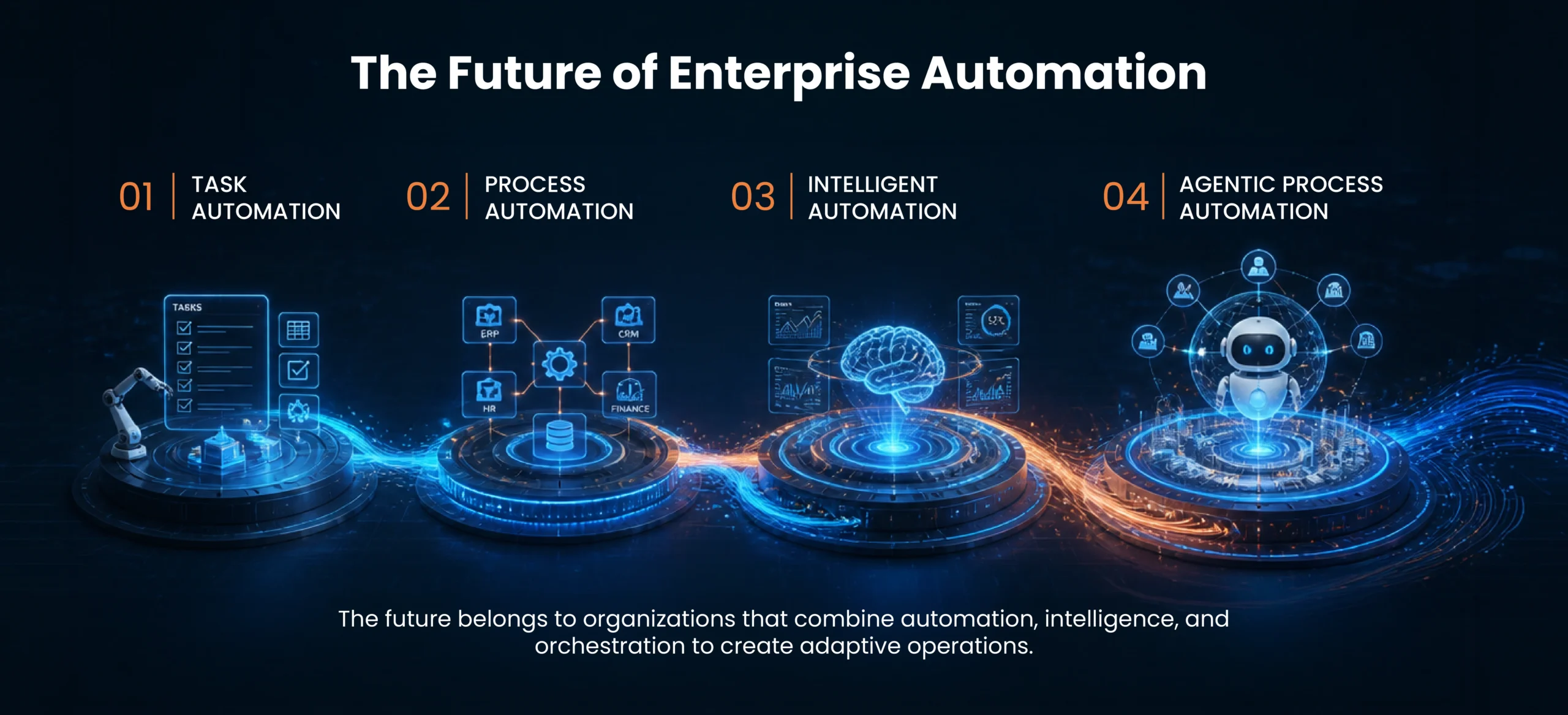
As organizations modernize platforms and workflows, automation increasingly becomes embedded within broader Product Engineering and Cloud Services strategies.
The role of RPA remains important.
In many ways, it is becoming foundational infrastructure for the next generation of automation.
NewVision Perspective
Organizations often ask:
“How many processes can we automate?”
Leading organizations ask:
“How intelligently can our business operate?”
That distinction is becoming increasingly important.
The most successful automation initiatives today are not defined by the number of bots deployed. They are defined by how effectively they improve the flow of work, decisions, and information across the business.
As automation continues to evolve, the greatest opportunity may not be automating more tasks.
It may be creating more intelligent, agile, and adaptive organizations.
References
Gartner – What Is Hyperautomation?
https://www.gartner.com/en/articles/what-is-hyperautomation
Microsoft – Work Trend Index
https://www.microsoft.com/worklab/work-trend-index
UiPath – Automation Trends and Industry Insights
https://www.uipath.com/resources/automation-trends
Enterprise automation continues to evolve as organizations combine automation, AI, orchestration, and process intelligence to create more adaptive operations.