AI has moved from experimentation to expectation.
For mid-market enterprises, the conversation is no longer whether to adopt AI. It is how to integrate it without diluting focus or capital discipline.
Speed alone is not the differentiator.
Structure is.
Across boardrooms, AI is now a strategic priority. Budgets are allocated. Platforms are licensed. Pilots are underway. Teams are exploring generative AI, predictive models, and intelligent automation. Intent is clear.
What separates leaders is cohesion.
Unlike large enterprises that can distribute risk across multiple initiatives, mid-market organizations operate with tighter execution bandwidth and sharper investment thresholds. AI must deliver measurable performance impact. Fragmented adoption does not create advantage. Alignment does.
Sustained AI impact begins when leadership treats it as a business capability rather than a technology layer.
Why an AI Strategy for Mid-Market Companies Requires Structural Discipline
AI strengthens clarity. It sharpens decision-making. It increases operational throughput. But its value compounds only when the underlying ecosystem is aligned.
Connected and governed data produces reliable insight.
Refined processes convert automation into acceleration.
Defined executive ownership transforms pilots into capability.
An effective AI strategy for mid-market companies begins with identifying where AI can materially influence revenue growth, cost stability, or operational scalability. Without that anchor, adoption remains incremental rather than transformational.
The critical question is not how to adopt AI. It is where AI can elevate enterprise performance.
That shift changes the trajectory.
High-performing organizations deploy AI in response to strategic priorities. Revenue expansion. Forecast precision. Cost stability. Customer retention. Scalable operations. Technology follows business intent.
AI becomes a precision instrument embedded in performance drivers.
From AI Readiness Assessment to Scalable AI Adoption
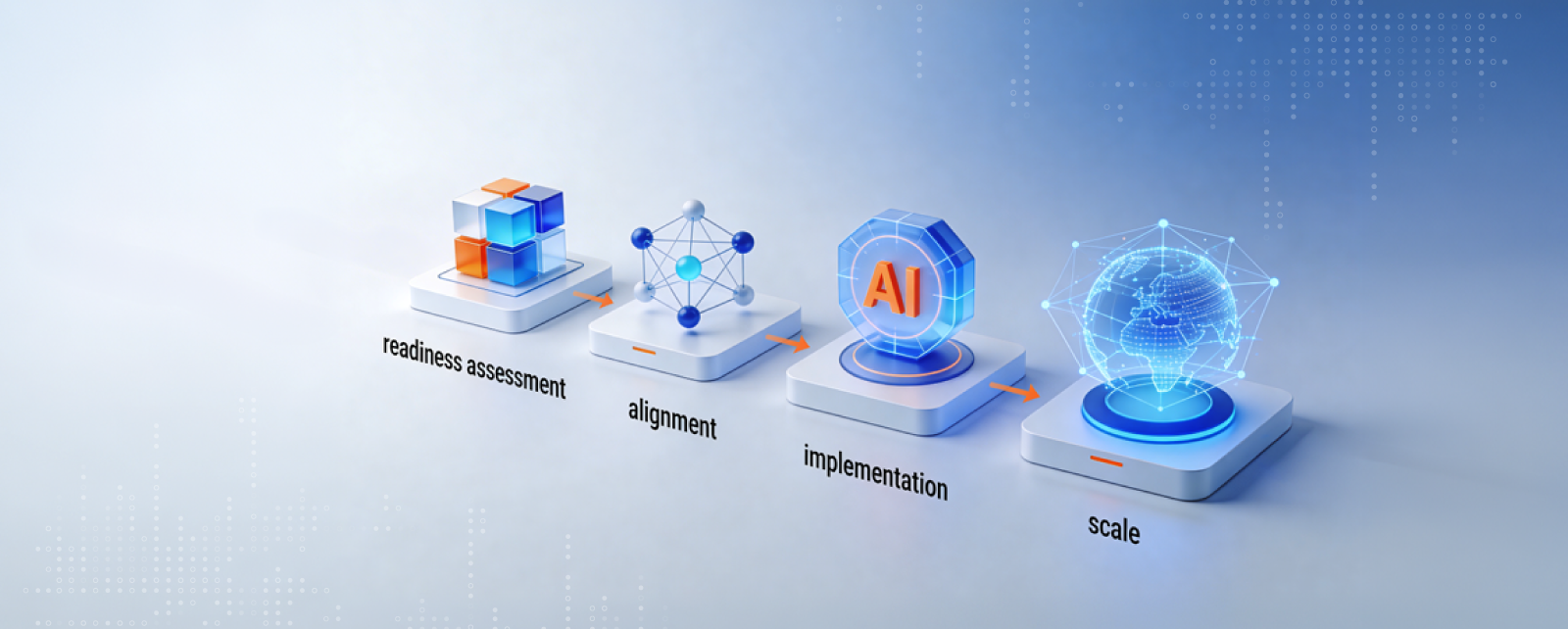
Many mid-market companies are already investing in AI tools. The inflection point comes when these initiatives are unified under structured readiness assessment, clear prioritization, and accountable governance.
A disciplined AI readiness assessment evaluates data maturity, executive alignment, process integrity, and governance safeguards before large-scale deployment begins. This foundation determines whether AI scales smoothly or stalls under complexity.
Through the SmartVision framework at NewVision, organizations transition from isolated experimentation to structured AI implementation. The objective is not tool proliferation. It is architectural coherence before scale.
Enterprise-grade impact emerges when alignment precedes expansion. When business outcomes guide capability decisions. When success metrics are defined before deployment. When governance evolves alongside implementation.
This is structured velocity.
Building a Scalable AI Implementation Roadmap Without Losing Focus
AI is often positioned as a cost-reduction lever. Efficiency gains are real. The greater opportunity, however, lies in performance amplification.
AI can sharpen decision cycles, improve predictability, stabilize operational output, and extend service capacity without linear headcount expansion. When integrated into core business drivers, it strengthens competitive positioning.
A scalable AI implementation roadmap does not begin with enterprise-wide rollout. It begins with clarity of purpose, measurable impact, and operating model integration. Scale follows validation, not ambition.
Governance has become a leadership mandate. As AI shapes customer experience and operational decisions, responsible oversight reinforces trust. Clear accountability, transparent data practices, and auditable systems signal maturity to customers, partners, and boards.
Mid-market enterprises possess inherent structural strengths. Shorter decision pathways. Cross-functional visibility. Executive proximity to operational friction. When AI is infused deliberately into this ecosystem, those strengths compound.
The organizations that will lead over the next five years will not be those that experimented most aggressively. They will be those that embedded AI deliberately. Those that treated it not as a technology initiative, but as an extension of enterprise strategy.
AI rewards alignment.
For mid-market enterprises, alignment is the accelerator.
The advantage will not belong to those who moved first.
It will belong to those who structured it best.
FAQ:
Frequently Asked Questions About AI Strategy for Mid-Market Companies
What is the first step in building an AI strategy for a mid-market company?
The first step is conducting a structured AI readiness assessment. This evaluates data maturity, business alignment, governance safeguards, and executive ownership before large-scale AI deployment begins.
How long does it take to implement an AI strategy?
Most organizations begin with a focused pilot that runs between 30 and 90 days. Scalable AI adoption typically follows phased expansion aligned to measurable business outcomes.
What are common AI use cases for mid-market enterprises?
Common high-impact use cases include intelligent automation of manual workflows, predictive forecasting, customer churn analysis, support ticket classification, and operational performance optimization.
What is the difference between AI adoption and AI strategy?
AI adoption refers to deploying tools. An AI strategy aligns those tools to business objectives, defines measurable success metrics, establishes governance, and creates a scalable implementation roadmap.
How do you measure ROI from AI initiatives?
AI ROI is measured through operational metrics such as cycle-time reduction, cost optimization, accuracy improvement, revenue lift, and customer satisfaction enhancement.