
A history of the Agile Manifesto and why what happened in a Utah ski resort still shapes every software team on the planet.
The World Before Agile
In the 1990s, building software looked a lot like building a bridge.
You planned everything upfront. You wrote hundreds of pages of requirements before a single line of code was written. Those documents were handed to development teams, who would often disappear for months, sometimes even years, before returning with a finished product.
This was the Waterfall model. And on paper, it made perfect sense. Define the problem. Design the solution. Build it. Test it. Ship it.
The problem was that reality rarely cooperated.
By the time software finally shipped, the business had moved on. Customer expectations had changed. Markets had evolved. Products that emerged after eighteen months of silence often looked very different from what users actually needed. Projects ran over budget. Deadlines slipped. Teams had no practical way to adapt because the process itself resisted change.
The software industry knew something was broken. It just didn’t yet know what would replace it.

In February 2001, seventeen software developers, consultants, and thinkers boarded flights to Salt Lake City, Utah.
They were not a standards committee. They were not backed by governments or large corporations. They were a loosely connected group of practitioners who had each, independently, arrived at the same uncomfortable conclusion: the software industry was optimising process at the expense of progress.
Some had already spent years experimenting with alternatives. Kent Beck had been developing Extreme Programming. Jeff Sutherland and Ken Schwaber were shaping Scrum. Ward Cunningham, who would later create the wiki, was there. So was Martin Fowler, one of the most respected voices in software engineering.
They checked into the Snowbird ski resort and spent three days talking about what software development should become.
What emerged was not a methodology. It was not a framework, certification, or project management system.
It was a statement of values.
The message was remarkably simple, yet enduring.
What the Manifesto Actually Said
The Agile Manifesto opened with a single sentence:
“We are uncovering better ways of developing software by doing it and helping others do it.”
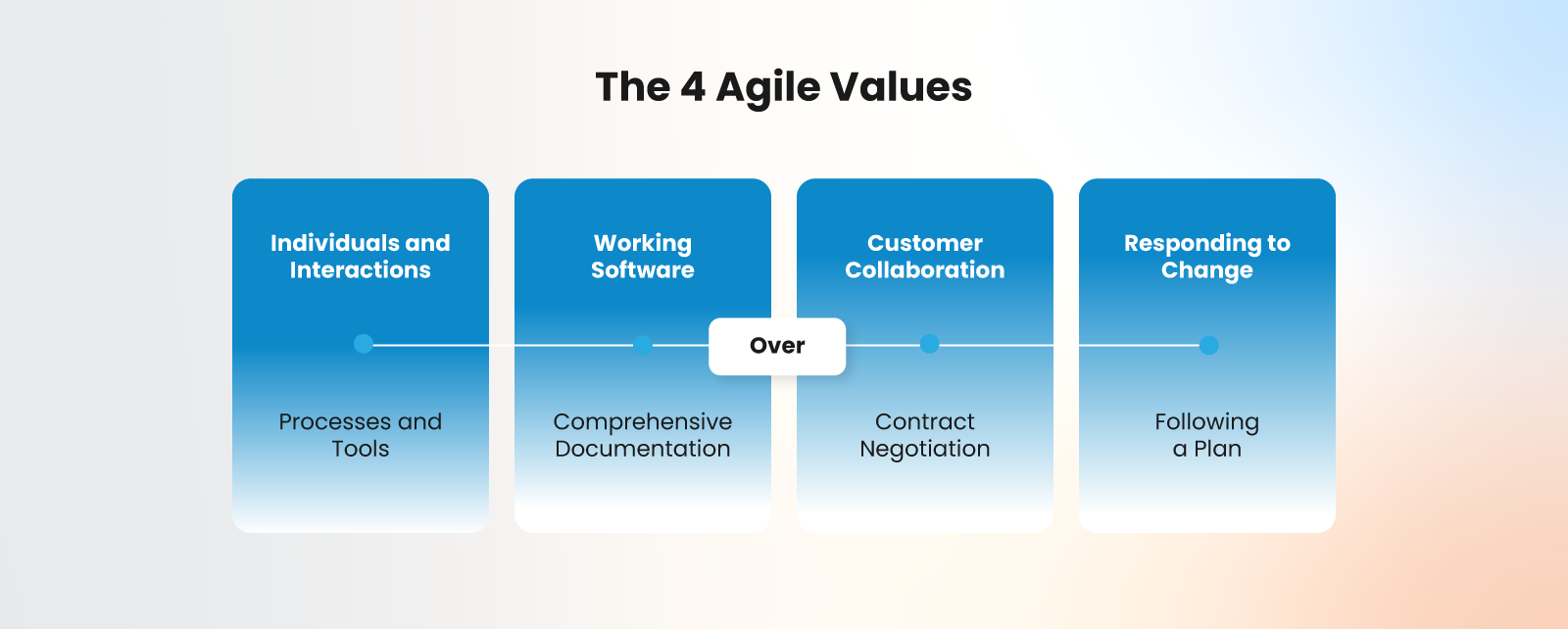
Then came the four values that would reshape modern software development:
The nuance mattered.
The manifesto never claimed the items on the right had no value. In fact, it explicitly stated:
“While there is value in the items on the right, we value the items on the left more.”
This was not a rejection of planning or documentation. It was a reordering of priorities.
It prioritised people over bureaucracy, delivery over paperwork, and adaptability over rigidity.
At its core, the Agile Manifesto was less about software mechanics and more about philosophy. It challenged the industry to rethink how teams worked, communicated, and responded to uncertainty.
What Happened Next
The manifesto was published quietly at agilemanifesto.org.
There was no launch event. No PR campaign. No corporation behind it.
Yet within a few years, it had fundamentally changed how software teams operated around the world.
Scrum introduced sprints, standups, retrospectives, and iterative delivery cycles. Kanban brought visual workflow management and continuous flow. SAFe adapted Agile principles for large enterprises operating at scale.
Each framework interpreted Agile differently. Each introduced its own structure and practices. But all of them traced their origins back to the same core idea: software teams needed to become more adaptive, collaborative, and responsive to change.
Today, Agile is no longer a niche philosophy. Industry surveys consistently show that the vast majority of software organisations use some form of Agile methodology in their development lifecycle.
It is not a trend anymore.
It is the default language of modern software delivery.
Why Agile Worked
Most manifestos fade away. Most industry movements lose relevance over time.
The Agile Manifesto endured because it arrived at exactly the right moment.
The early 2000s exposed the limitations of traditional software delivery at a massive scale. The dot-com bubble had burst. Companies had invested billions into projects that shipped late, exceeded budgets, or failed entirely. Teams were frustrated. Businesses had lost trust in long delivery cycles.
The industry was ready for a different way of thinking.
But timing alone does not explain why Agile lasted.
What made the manifesto powerful was its restraint. It told teams what to value, not exactly what to do. That flexibility allowed different frameworks, industries, and organisations to interpret Agile in ways that suited their context.
The manifesto became a foundation rather than a rigid blueprint.
And foundations tend to outlive frameworks.
Where Agile Stands Today
Twenty-five years after Snowbird, Agile is everywhere, and that widespread adoption has created its own challenges.
The term is now so widely used that it sometimes risks losing meaning altogether. Organisations describe themselves as Agile while still operating through rigid annual planning cycles. Teams conduct daily standups without understanding their purpose. Ceremonies get adopted while the mindset behind them is ignored.
This phenomenon is often called Agile theatre.
In many cases, the rituals survived while the philosophy behind them did not.
Ironically, the manifesto itself warned against this kind of thinking. Its principles emphasise continuous improvement, sustainable delivery, technical excellence, and close collaboration. They describe a way of approaching work, not a checklist of meetings.
The people who met at Snowbird were not trying to create more process.
They were trying to make software development more collaborative, adaptive, and ultimately more human.
Why the Core Principle Still Matters
One principle from the Agile Manifesto remains especially relevant in today’s environment:
“Welcome changing requirements, even late in development.”
In 2001, that meant adapting when client expectations evolved midway through a project.
In 2026, the stakes are even higher.
AI-native products now evolve weekly, customer expectations shift rapidly, and markets move in months rather than years.
Modern Agile is no longer defined only by speed; it is increasingly defined by responsiveness.
The tools and frameworks will continue to evolve. But the underlying principle remains timeless: the teams that succeed are the ones built to learn, adapt, and improve continuously.
That is why a short manifesto written by seventeen people at a ski resort in Utah continues to influence how the world builds software today.
At NewVision Software, we have been helping engineering teams build with Agile principles at the core since 2016 across product engineering, intelligent automation, and digital transformation.
If you would like to explore how modern Agile practices can accelerate delivery while keeping teams adaptable at scale, we invite you to connect with us.