

Wondering how cloud services have evolved over decades? And how can you benefit from them?
Cloud services have come a long way since their inception in the mid-1940s. From distributed servers to virtual computing systems, the concept of cloud computing has evolved rapidly over time.
But if you look closely, this evolution is not just about technology.
It is about removing limitations.
Every phase, from early computing systems to today’s AI-driven cloud, has solved a constraint business once had to live with.
What is Cloud Computing?
Cloud computing is a model of delivering computing services including servers, storage, databases, networking, software, analytics, and intelligence over the Internet with the ability to scale up or down as needed.
It allows organizations to access and manage IT resources without building and maintaining their own data centers. This makes it a cost-effective and flexible solution for businesses of all sizes.
How Cloud Computing Works?
There are two sub-systems involved in the working of a cloud computing system.
Front-end
It enables the user to access the stored data using an Internet browser.
Backend
The backbone of cloud computing, the backend is responsible for everything that happens at the front end. The central server works through a set of protocols to facilitate operations.
For this, the server uses software and middleware to ensure seamless connectivity between devices linked via the cloud.
Additionally, cloud service providers maintain multiple copies of data to prevent data loss, breaches, and system failures.
The Evolution of Cloud Services
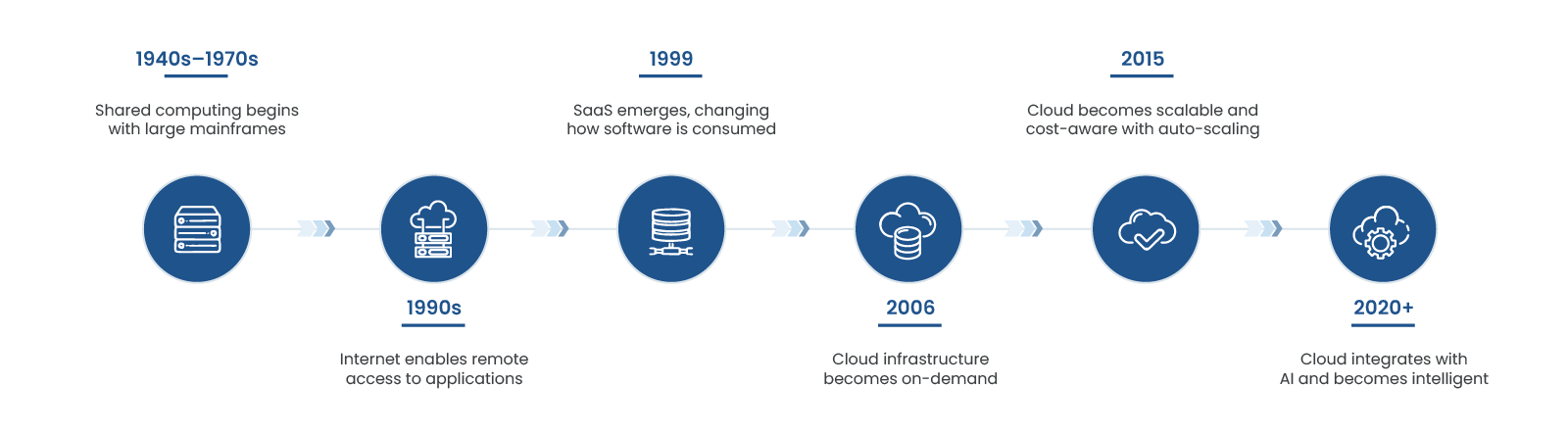
1940s to 1950s: When Computing Was Rare and Powerful
Early machines like the ENIAC were not built for convenience. They were built out of necessity.
ENIAC was designed during World War II to calculate artillery trajectories. It filled entire rooms and consumed enormous power, yet it performed calculations faster than anything that existed before.
But here is the interesting part.
Not everyone could own such a machine. So people shared it.
That simple act of sharing computing power introduced the first idea that would later define cloud. You do not always need to own infrastructure to use it.
1960s: When Computers Started Talking to Each Other
In the 1960s, J. C. R. Licklider imagined a world where computers could communicate across locations.
This idea became reality with ARPANET.
For the first time, data moved between machines in different places.
Think about how fundamental this was.
Before this, computing was isolated. After this, it became connected.
This shift quietly introduced the idea that computing did not have to live in one place.
1970s: When One Machine Became Many
In 1972, IBM VM Operating System introduced virtualization.
Instead of one machine doing one job, a single system could now behave like multiple machines.
For businesses, this meant better utilization of resources.
For technology, it meant abstraction had begun.
This is where the foundation of modern cloud infrastructure was laid, even though no one called it cloud yet.
1990s: When the Internet Changed Access
By the 1990s, the internet had started reaching businesses and homes.
Suddenly, the idea of accessing software remotely did not seem impossible anymore.
Instead of installing software on every machine, it could be accessed through a browser.
Imagine a company before this era. Every system had to be set up individually. Every update had to be installed manually.
Now compare that to accessing a tool from anywhere with just an internet connection.
This was the beginning of convenience in computing.
1999: When Software Became a Service
When Salesforce launched in 1999, it introduced a new way of thinking.
Businesses no longer needed to install complex CRM systems. They could simply log in and use it.
This was the beginning of Software as a Service.
It was not just about technology.
It was about removing friction for businesses.
2006: When Infrastructure Became On Demand
The launch of Amazon Web Services in 2006 changed the game completely.
For the first time, businesses could access servers, storage, and computing power without setting up physical infrastructure.
If a startup needed 10 servers, they could get them instantly.
If they needed 100 the next day, they could scale without buying hardware.
Soon, platforms like Microsoft Azure expanded these capabilities further.
This is where cloud stopped being an experiment and became a real business decision.
What Changed at Each Stage
Cloud did not evolve randomly. Each phase solved a specific limitation:
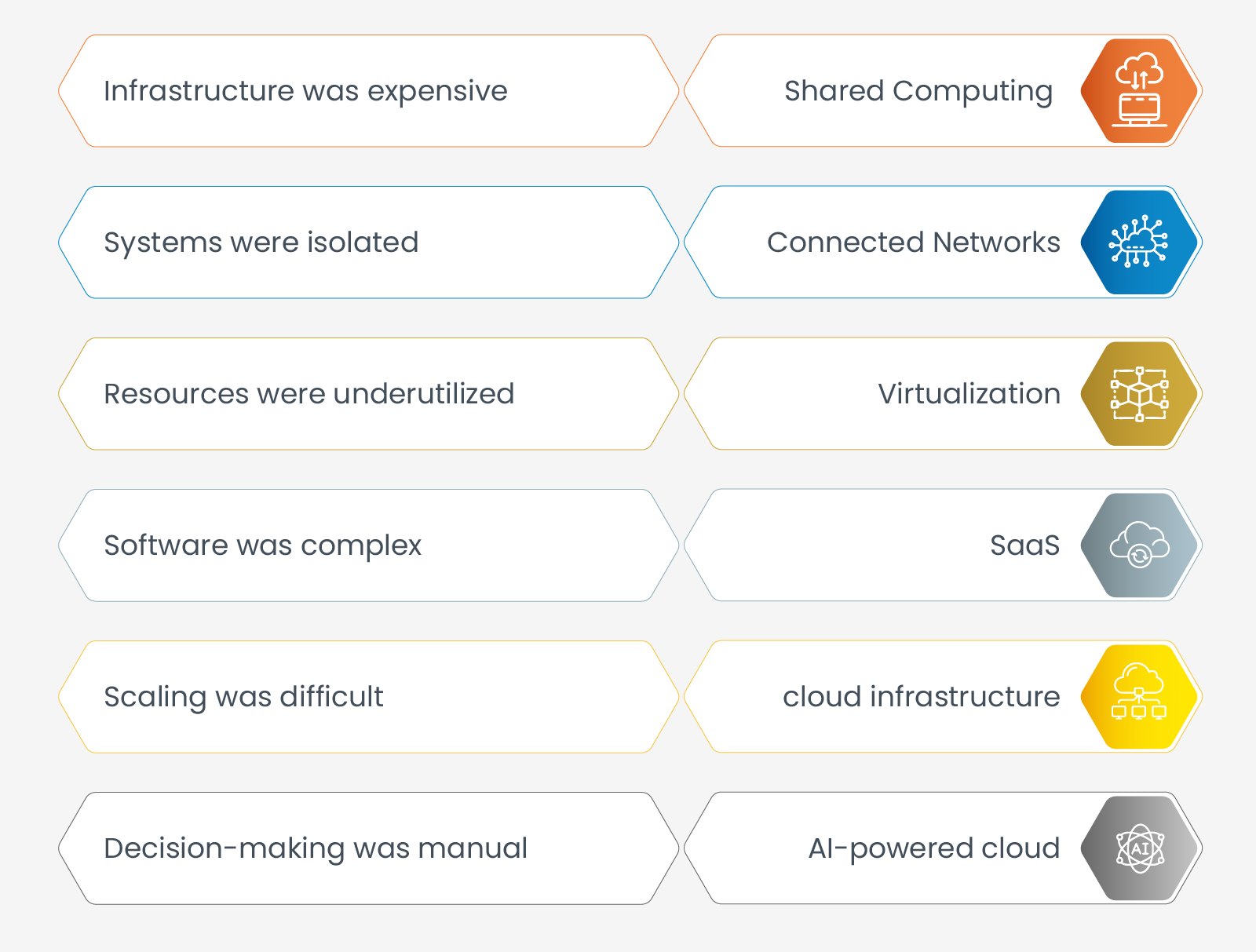
This is what makes cloud evolution different.
It did not just add capabilities. It removed constraints.
Around 2015: When Cloud Became Smart About Scale and Cost
As adoption grew, a new challenge appeared. Managing cloud efficiently.
Around 2015, cloud platforms became more intelligent with features like:
- auto scaling based on demand
- refined usage-based billing
- improved monitoring and cost visibility
For example, an e-commerce platform during a festive sale no longer had to predict traffic manually.
The system could automatically scale up when users increased and scale down when demand reduced.
This is where cloud started becoming not just scalable, but efficient.
2020 to 2022: When Cloud Met AI
The next phase of evolution came when cloud started integrating deeply with AI.
Cloud platforms began offering built-in capabilities for:
- machine learning
Now, businesses were not just running applications on the cloud.
They were building intelligent systems on top of it.
For example, a customer support system could analyze user queries, suggest responses, and automate workflows without manual intervention.
This marked the shift from cloud as infrastructure to cloud as an intelligent platform.
Think of It This Way
Cloud started like a shared resource.
Then it became a connected system.
Then it became something you could access from anywhere.
Today, it has become intelligent enough to assist and optimize decisions.
Cloud Today: More Than Infrastructure
Today, cloud computing is not just about servers or storage.
It is about enabling innovation.
Modern trends include:
- AI in cloud computing
- serverless architectures
- multi-cloud strategies
- edge computing
- cloud cost optimization
Cloud has become the foundation on which modern digital systems are built.
Closing Thought
If you look at the journey closely, cloud computing has always moved in one direction.
From complexity to simplicity.
From limitation to possibility.
What started as shared machines in the 1940s has now evolved into intelligent, scalable ecosystems.
And if this journey tells us anything, it is this.
Cloud will continue to evolve, because the next problem is always waiting to be solved.