For decades, enterprise software quality evolved around a relatively stable assumption: systems were designed to behave predictably. Applications followed predefined logic, workflows operated within expected boundaries, and outputs could be validated against known conditions. Quality assurance, therefore, focused primarily on ensuring reliability, functional correctness, performance stability, and release confidence across increasingly complex digital ecosystems.
That model shaped the foundation of modern software engineering and served enterprises exceptionally well through multiple waves of technological transformation.
What is beginning to change now, however, is not simply the velocity of software development. It is the nature of software systems themselves.
Generative AI introduces a fundamentally different operational dynamic. Instead of executing only deterministic instructions, AI systems increasingly generate responses contextually, adapt dynamically, and evolve based on prompts, interaction patterns, orchestration layers, and underlying model behaviour. In many cases, the same request can produce different outputs depending on context, data conditions, or conversational state.
This significantly expands the role of assurance.
Enterprises are no longer validating only whether software behaves correctly under predefined conditions. Increasingly, they are trying to determine how intelligent systems can be governed, evaluated, and trusted consistently across continuously evolving business environments.
That transition may significantly expand how enterprises define software quality and assurance in AI-driven environments.
The Shift Happening Inside Enterprise Assurance
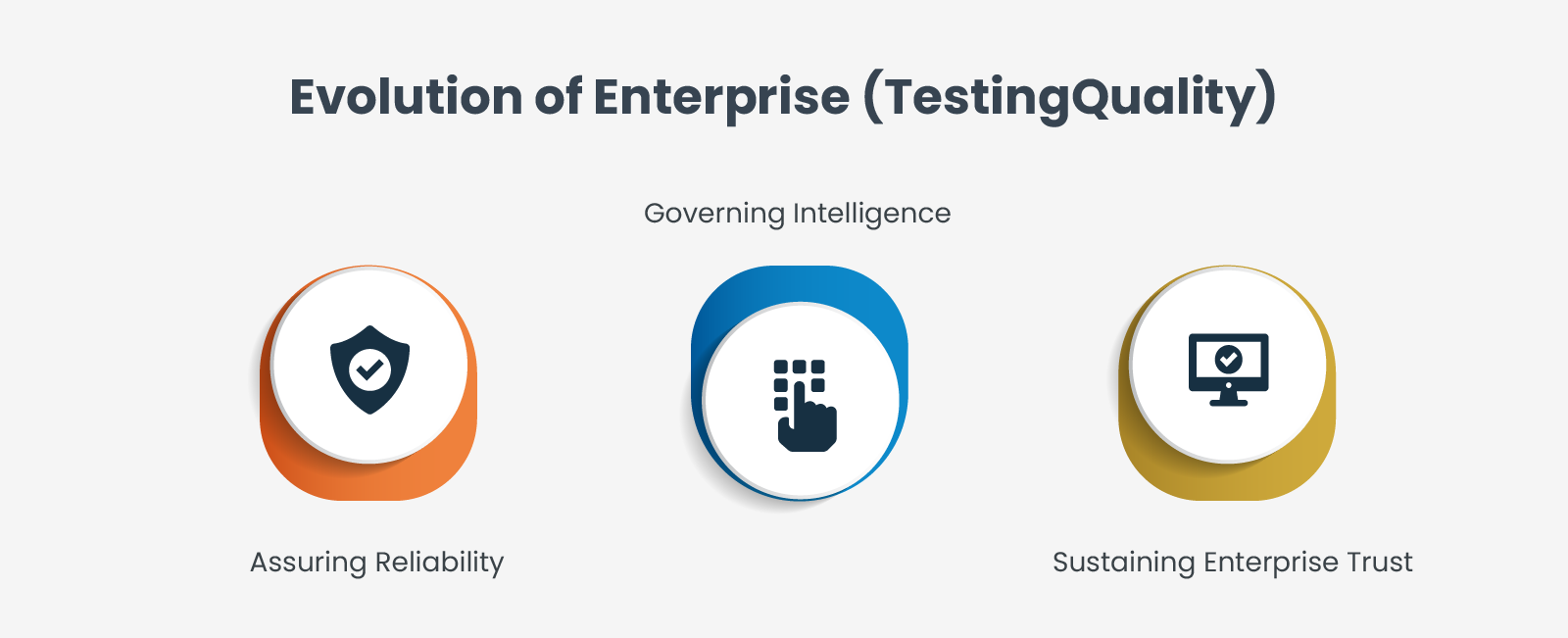
One of the most significant developments emerging across enterprises today is that digital assurance is gradually evolving beyond its traditional role as a validation function within the software lifecycle.
For years, testing was often viewed primarily as a release checkpoint or operational requirement designed to support delivery confidence. Success was typically measured through metrics such as defect reduction, automation coverage, execution speed, and production stability. While those capabilities remain critical, Gen AI is introducing a broader layer of enterprise responsibility around software behavior itself.
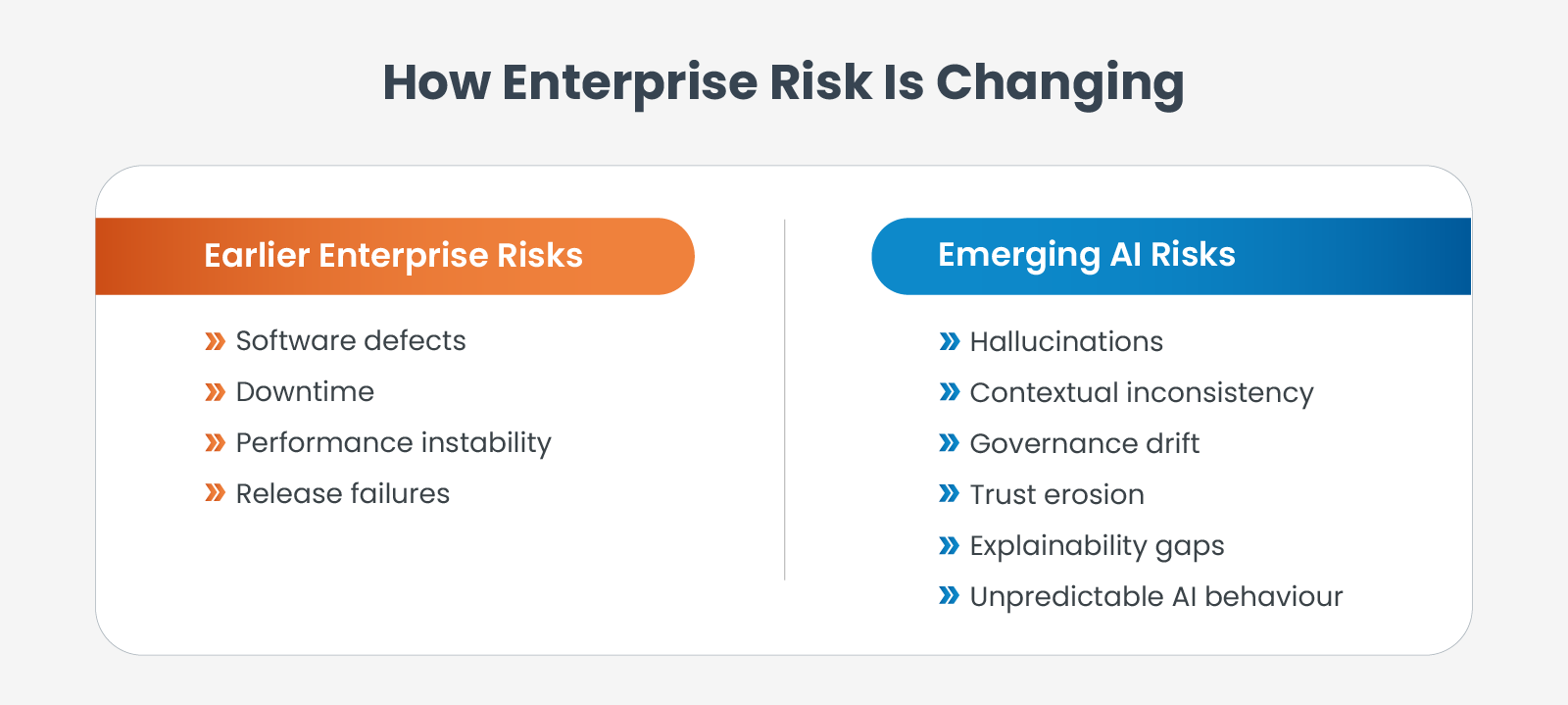
Traditional software defects typically created operational disruptions, workflow inefficiencies, or performance instability. AI-driven systems introduce a different category of enterprise exposure involving hallucinations, contextual inconsistency, explainability challenges, governance drift, bias risks, and unpredictable decision behavior. These are no longer isolated technology concerns. Increasingly, they influence enterprise trust, customer confidence, operational governance, and organizational credibility at scale.
This changes the strategic importance of assurance significantly.
Because the challenge is no longer limited to whether software functions correctly. Enterprises are increasingly trying to determine whether intelligent systems can operate responsibly, consistently, and reliably across dynamic real-world conditions where outcomes may evolve contextually over time.
That transition elevates assurance into something much larger than testing alone.
It gradually becomes part of how organizations preserve operational confidence across AI-driven environments.
Why Enterprises Are Rethinking Assurance Models
The pace of Gen AI adoption across enterprises is accelerating faster than many assurance environments were originally designed to accommodate.
Organizations are rapidly integrating AI into customer operations, software engineering pipelines, internal productivity systems, analytics environments, enterprise search, decision-support systems, and digital experiences. At the same time, AI-assisted software generation is significantly increasing development velocity across modern delivery ecosystems.
This creates an important operational imbalance.
Software generation is accelerating rapidly, while assurance maturity across AI environments is evolving more gradually.
As a result, many enterprises are beginning to encounter what can best be described as an emerging assurance gap. Not because traditional quality engineering practices are becoming irrelevant, but because assurance objectives themselves are changing fundamentally.
Earlier quality models focused heavily on deterministic validation. Systems were expected to produce predefined outputs under controlled conditions. Gen AI systems introduce probabilistic behaviour where outputs may vary contextually and operational responses can evolve dynamically over time.
That creates a much more complex enterprise reliability environment.
Organizations now need assurance models capable of evaluating not only functional behaviour, but also contextual reliability, governance alignment, trustworthiness, explainability, operational consistency, and risk exposure across AI-driven systems.
This is one of the reasons digital assurance is beginning to move closer to enterprise strategy conversations rather than remaining isolated within engineering functions alone.
The Trust Gap Enterprises Are Beginning to Face
One of the more important enterprise realities emerging today is that organizations can scale AI adoption remarkably fast while enterprise trust models evolve much more slowly.
This creates a growing trust gap between what intelligent systems are capable of generating and what organizations can confidently operationalize at scale.
That gap carries significant implications.
Earlier assurance environments focused primarily on validating software reliability before deployment. AI environments increasingly require organizations to evaluate reliability dynamically as systems evolve across changing operational conditions.
Periodic validation alone is becoming insufficient for many AI-driven operational environments.
This fundamentally changes how enterprises need to think about assurance itself.
Because digital assurance is no longer centered only around release confidence.
Increasingly, it becomes responsible for supporting enterprise confidence across evolving AI-enabled operations.
That is a much larger operational responsibility than traditional testing environments were originally designed to support.
What Digital Assurance Is Becoming
The organizations approaching AI adoption most effectively are rarely treating assurance as an isolated testing activity. Instead, they are beginning to build connected assurance ecosystems where governance, observability, AI monitoring, automation, operational intelligence, and quality engineering work together across enterprise environments.
This creates a more adaptive assurance model that operates much closer to real-world enterprise conditions.
Validation becomes more continuous rather than periodic. Risk visibility expands across operational workflows. Assurance environments become increasingly contextual, dynamic, and intelligence-aware. And quality engineering gradually shifts from validating static functionality toward evaluating evolving operational reliability.
That transition significantly changes the role of assurance across the organization.
Over time, digital assurance may increasingly function as an enterprise trust capability that helps organizations maintain confidence in AI-driven operations at scale.
This shift is especially visible in customer-facing AI environments.
Traditional assurance models primarily focused on validating whether workflows functioned correctly across predefined scenarios. Modern AI assurance environments increasingly require organizations to evaluate whether systems can sustain contextual consistency, governance alignment, response reliability, and operational confidence across continuously evolving user interactions.
Those are fundamentally different assurance objectives.
And they may ultimately reshape how enterprises approach software quality in AI-driven environments.
What Changed in Enterprise Assurance
Traditional QA focused on validating whether systems behaved correctly under predefined conditions.
Digital assurance for Gen AI increasingly focuses on evaluating reliability, governance alignment, contextual consistency, and enterprise confidence across evolving operational environments.
AI Is Reshaping the Strategic Role of Quality Engineering
AI is also transforming the strategic role of quality engineering itself.
For years, quality organizations concentrated heavily on test execution, automation frameworks, defect management, and release stability. Those responsibilities continue to remain essential. What is changing now is the operational significance of assurance across enterprise AI ecosystems.
Quality engineering is increasingly intersecting with governance, operational intelligence, AI observability, trust evaluation, contextual validation, behavioral monitoring, and enterprise risk management. Assurance teams are gradually moving closer to environments traditionally associated with strategic operational oversight rather than remaining limited to software validation alone.
This evolution may significantly elevate the importance of assurance across enterprises adopting AI at scale.
Because in AI-driven environments, quality is no longer measured only through functional correctness. Increasingly, it is measured through how reliably organizations can maintain operational confidence in intelligent systems operating across dynamic business conditions.
That distinction changes the enterprise relevance of assurance considerably.
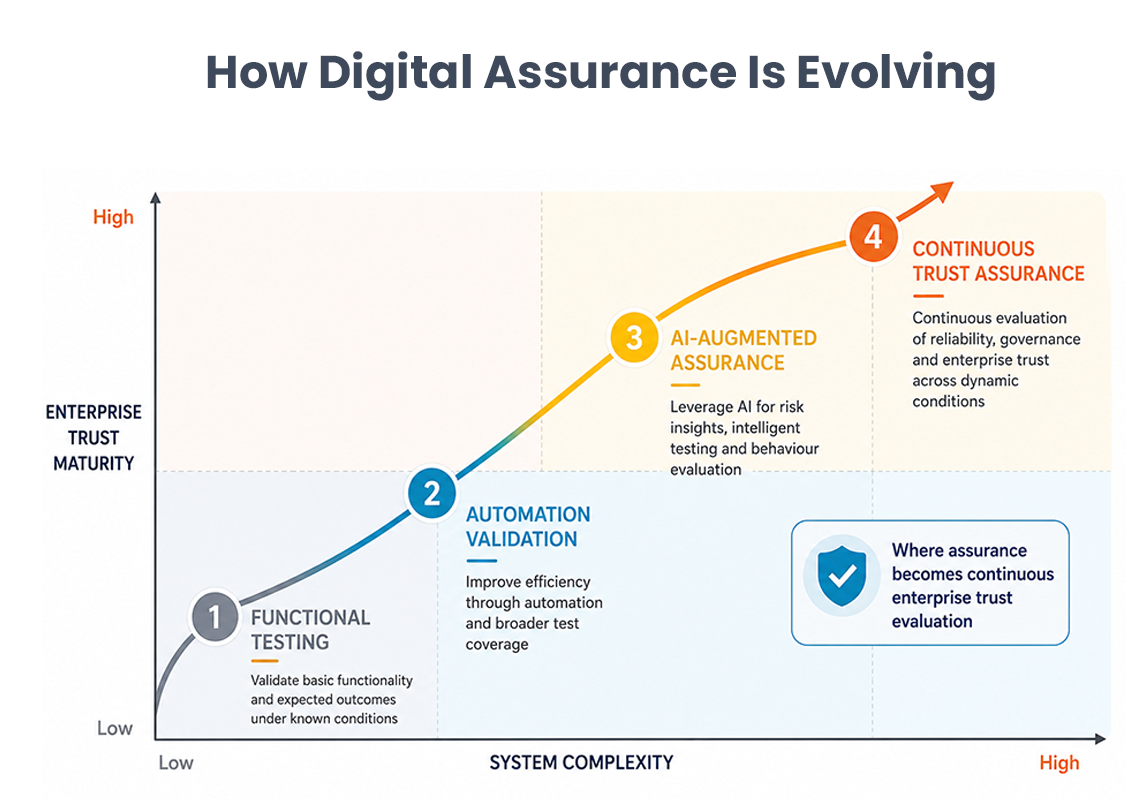
The Future of Assurance May Become More Adaptive
The future of digital assurance will likely extend far beyond periodic testing cycles and predefined validation models.
Cloud, AI, observability, automation, governance, and operational intelligence are steadily converging into assurance environments capable of evaluating enterprise systems across changing operational conditions more dynamically than traditional models allowed. This may gradually shift assurance from a reactive delivery discipline into a more adaptive operational capability embedded directly within enterprise ecosystems.
Organizations that evolve assurance capabilities alongside AI adoption are likely to create stronger governance maturity, operational confidence, and enterprise resilience over time.
Because in the years ahead, the defining enterprise challenge may no longer be whether organizations can build intelligent systems.
It may increasingly become whether organizations can govern, evaluate, and rely on those systems responsibly at scale.
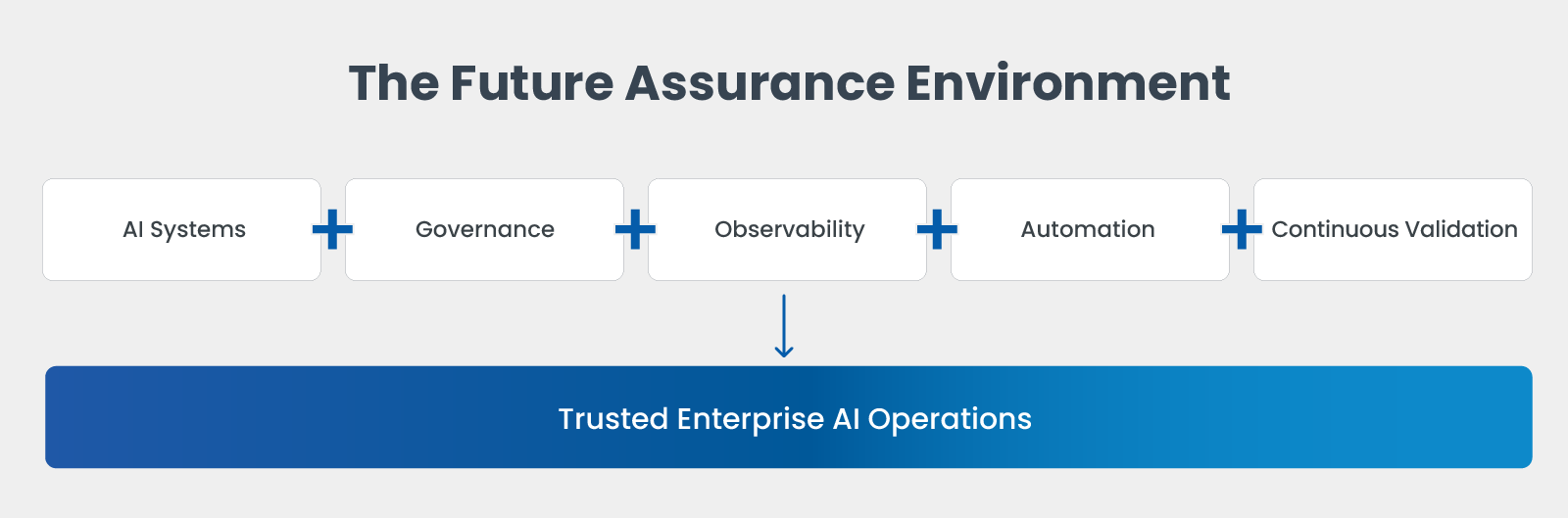
Bringing It All Together
Generative AI is often discussed primarily through the lens of productivity, acceleration, and automation. Its broader enterprise impact, however, may be much more foundational.
Gen AI is gradually reshaping how organizations think about software quality, operational reliability, governance maturity, enterprise trust, and assurance itself. Enterprises spent decades optimizing software delivery around deterministic systems designed to behave predictably. What is emerging now is an environment where systems can generate adaptive outputs, evolve contextually, and continuously influence enterprise operations dynamically in real time.
That changes the meaning of quality assurance fundamentally.
And over time, the organizations creating the strongest enterprise advantage may not necessarily be the ones capable of generating intelligent systems the fastest. They may increasingly be the organizations capable of governing, assuring, and maintaining confidence in those systems across evolving operational environments.
NewVision’s Perspective
At NewVision Software, we believe digital assurance is evolving far beyond its traditional role as a validation function within the software lifecycle.
As enterprises increasingly adopt Gen AI systems, assurance is becoming a strategic enterprise capability responsible for supporting operational confidence across workflows, governance environments, intelligent systems, and enterprise interactions. This transition elevates assurance from a supporting delivery function into a foundational capability for enterprise trust in AI-driven operations.
Because the next generation of enterprise quality may ultimately be defined not only by how systems perform, but by how confidently organizations can govern, evaluate, and rely on intelligent systems operating dynamically at scale.
And in AI-driven enterprises, that ability to sustain operational confidence responsibly over time may become one of the most important strategic differentiators organizations can build.