Author: Dr. Vishwanathan C, Practice Head, AI and Analytics, NewVision Software
Last Updated: October 2026
Read time: ~10 min
The Number Every Business Leader Should Sit With
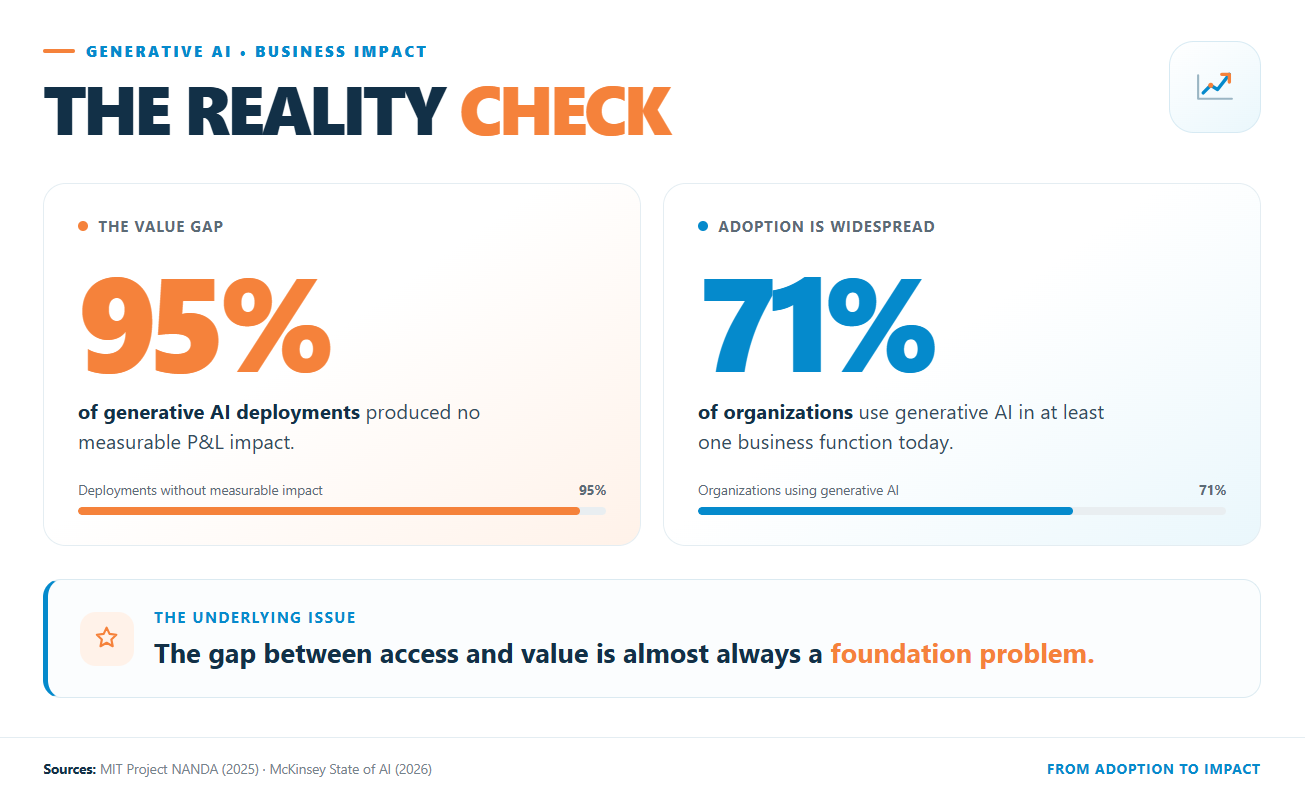
95%.
That is the share of generative AI deployments that have produced no measurable profit and loss impact, according to MIT Project NANDA’s 2025 study.
Nearly every organization has a generative AI initiative running somewhere. Most are still waiting for a line on the income statement to move because of it. And the reason, in almost every case, is the same: the technology was deployed before the foundation was ready. Data that was inconsistent, systems that were fragmented, outcomes that were never defined before the tools went live.
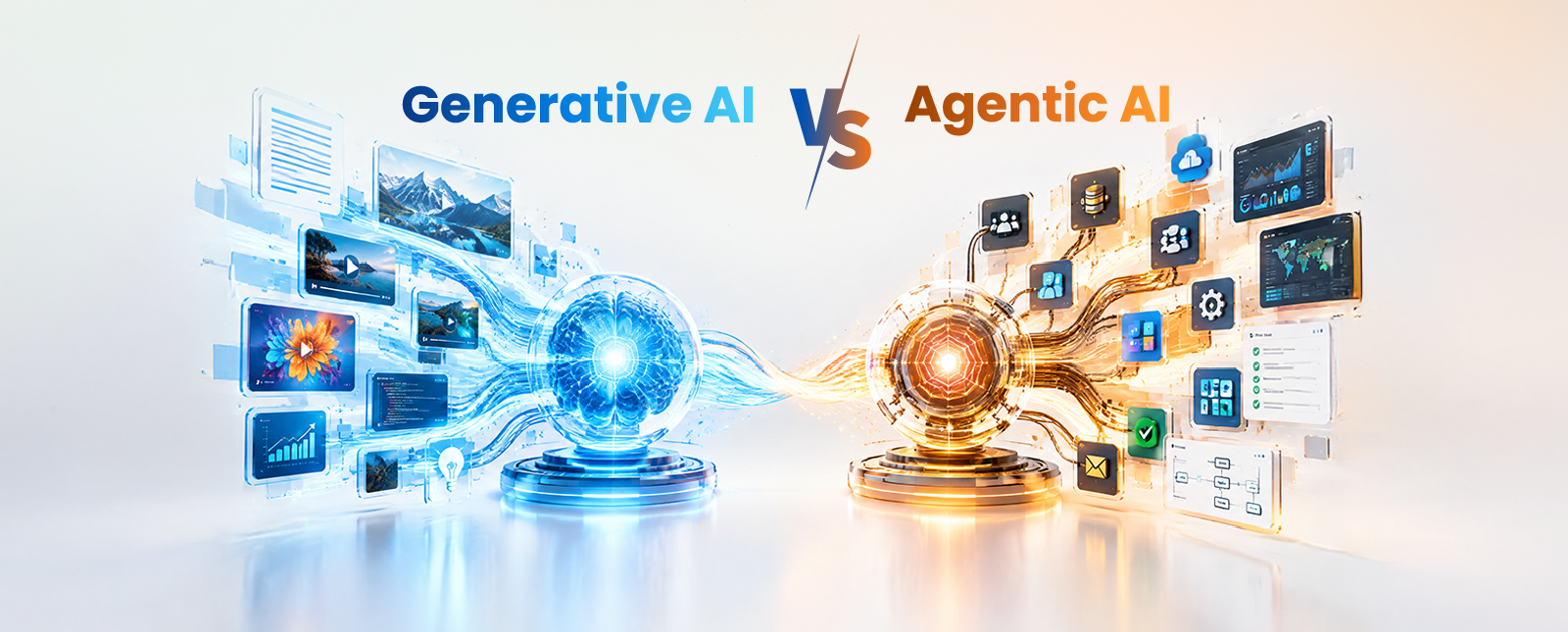
Before the business has fully processed that reality, the conversation has already shifted. The question in 2026 is no longer whether to use generative AI. It is whether to move to agentic AI.
It is the right question. It is just being asked without the harder one underneath it: do you understand what each approach genuinely requires, and which one your organization is actually ready for today?
This blog exists to answer that, with real data, a practical framework, and a perspective built from what we see working inside enterprise AI engagements.
What Generative AI Actually Does
Generative AI creates new content by learning patterns from existing data. Given a prompt or instruction, it produces text, images, code, audio, or video. But reducing it to a “content engine” understates what it can do in a well-integrated environment.
When connected to business systems, live data sources, and operational workflows, generative AI can surface contextually relevant answers, assist human decision-making with real-time information, and accelerate knowledge work at a scale that was previously impossible. A marketing team produces ten campaign variants before lunch. A developer reclaims hours previously spent on boilerplate. A customer service agent gets the right answer surfaced across five systems in seconds.
The McKinsey State of AI 2026 survey, fielded across 1,719 participants in 97 nations, confirms that 71% of organizations now use generative AI in at least one business function, up from 65% in early 2024. Productivity improvements of 15% to 30% are documented consistently across knowledge work functions. Companies investing in generative AI report an average return of 3.7 times their investment.
The productivity story is real. The value ceiling surfaces when the expectation shifts from accelerating what people do to transforming what the organization does. That is a different challenge, and it depends far more on data quality, system integration, and governance than on the AI model itself.
GENERATIVE AI AT A GLANCE
Primary strength
Content creation, knowledge-work acceleration, and system-connected assistance.
ROI timeline
1 to 3 months
Best for
Teams building AI confidence and productivity foundations.
What Agentic AI Actually Does
Agentic AI refers to AI systems designed to pursue goals autonomously across multiple steps, tools, and systems. Where generative AI responds to a prompt, agentic AI acts on an objective. It plans the steps required, executes them across connected systems, handles exceptions when something shifts, and delivers an outcome rather than an output.
The distinction is not that agentic AI is more powerful in an absolute sense. It is that agentic AI operates at a different level of autonomy and system dependency. A generative AI tool helps a customer service agent write a better response. An agentic AI system handles the entire interaction, checks the order system, processes the refund, updates the CRM, and sends the confirmation, without the agent involved at each step. The value created is different in kind, not just in degree.
The market data for 2026 reflects this shift. Gartner predicts 40% of enterprise applications will include task-specific AI agents by end of 2026, up from less than 5% in 2025. McKinsey finds 88% of agentic AI early adopters report positive ROI, compared to 74% for generative AI. McKinsey also projects agentic AI could add 2.6 to 4.4 trillion dollars in annual business value.
And yet: only 23% of organizations experimenting with agentic AI have successfully scaled it into production. And Gartner forecasts that over 40% of agentic AI projects currently underway will be cancelled by end of 2027.
That last number is the one this blog is really about, because the reason for those cancellations is almost always the same as the reason 95% of generative AI deployments never moved the P&L. The foundation was not there.
AGENTIC AI AT A GLANCE
Primary strength
Autonomous workflow execution and real-time decision-making across systems.
ROI timeline
6 to 12 months
Best for
Organizations with mature data foundations, integration architecture, and governance.
Generative AI vs Agentic AI
at a Glance
A practical comparison of execution models, autonomy, outcomes, and readiness.
| Comparison |
G
Generative AI
|
A
Agentic AI
|
|---|---|---|
|
Execution model
|
Responds to prompts | Acts on objectives autonomously |
|
System dependency
|
Can connect to systems | Requires reliable system integration |
|
Autonomy level
|
Human-directed | Human-governed, machine-executed |
|
Output
|
Content and assisted decisions | Actions and measurable outcomes |
|
Risk type
|
Informational | Operational |
|
ROI timeline
|
1 to 3 months | 6 to 12 months |
|
Foundation required
|
Moderate | High |
The Real Distinction: Response vs. Outcome
Generative AI improves how work gets done. Agentic AI changes what gets done, and by whom.
Both rely on the same underlying truth: the quality of what AI produces is inseparable from the quality of what it is connected to. Generative AI producing confident answers from inconsistent data is a reputational risk. Agentic AI making autonomous decisions on that same data is an operational risk that compounds automatically, at scale, across systems.
This is why the technology decision is always the second decision. The first is: what does our data look like? How well are our systems connected? Do we have the governance in place to know what AI can act on autonomously and where human judgment is required?
Organizations that answer those questions first are the ones delivering measurable outcomes. Organizations that skip to the technology choice are the ones driving the cancellation statistics.
A Three-Layer Way to Think About AI Readiness
Rather than asking “generative AI or agentic AI?”, the more useful question is: which layer of AI capability is your organization genuinely ready to execute at today?
Here is a practical way to think about it across three layers, Foundation, Integration, and Autonomy, each building on the stability of the one beneath it.
Layer 1: Foundation
This is where most organizations are today. AI accelerates individual tasks: generating content, summarizing documents, answering questions, supporting human decisions. The value is real and often visible within weeks. The process around those tasks, the systems and workflows, may be largely unchanged. The work here is also establishing data quality, access governance, and the organizational habits that make AI outputs trustworthy.
Layer 2: Integration
This is where AI connects to business systems, live data, and operational workflows in a meaningful way. AI outputs feed downstream processes. Context-aware decisions are made within a defined scope. The data foundation built at Layer 1 determines almost entirely how well this layer functions. Organizations that believe they are here but have not done the data work at Layer 1 will find Layer 2 consistently underdelivering.
Layer 3: Autonomy
This is where agentic AI operates, pursuing multi-step objectives across connected systems with minimal human intervention at each step. The ROI potential is highest here. So is the dependency on everything beneath it. Layer 3 built on a solid Layer 2 and 1 is transformational. Layer 3 attempted without that foundation is what Gartner is describing when it forecasts 40% cancellation rates.
It is worth being clear: Layer 3 is not the destination for every organization. Some will find that a well-executed Layer 2 delivers exactly the business outcomes they need. The framework is a readiness assessment, not a mandatory progression.
Three-Layer Readiness
A practical assessment of where your organization is today—not a hierarchy to climb.
Autonomy
Agentic AI pursuing objectives across systems.
Mature data, reliable integrations, and clear governance boundaries.
Integration
AI connected to live data and operational workflows.
Governed data, API architecture, and defined outcome metrics.
Foundation
AI accelerating individual tasks and building data quality.
Clean, accessible, governed data and organizational AI readiness.
From Assistance to Outcomes: A Single Example
Consider a procurement function handling supplier exceptions.
At Layer 1, a generative AI tool helps the procurement manager draft supplier communication faster and summarizes contract terms on demand. Individual productivity improves. The underlying process is unchanged.
At Layer 2, the AI connects to the supplier database, inventory system, and procurement platform. It surfaces exception alerts with relevant contract context already attached, recommends resolution options based on historical data, and prepares the communication for the manager to approve and send. The workflow accelerates. Human judgment still governs each decision.
At Layer 3, an agentic AI system monitors supplier performance continuously, detects an exception, identifies the clause, evaluates alternative suppliers against current inventory needs, initiates the approved resolution pathway, updates the relevant systems, and flags the outcome for human review. The manager governs the boundaries. The agent handles the execution.
Each layer delivers value. The right layer for any organization depends on whether the data, the integrations, and the governance are genuinely ready to support it.
Where Each Approach Delivers: A Practical Guide
Generative AI is the stronger choice when:
The primary goal is productivity and knowledge work acceleration. Teams are building AI confidence and data literacy. Workflows involve human judgment and variable outputs where review adds real value. The business needs returns within one to three months. The data and integration foundation is still being established.
In practice: marketing content at scale, software development acceleration, customer service agent assistance, document review and summarization, knowledge retrieval across complex information environments.
Agentic AI is the stronger choice when:
The goal is end-to-end process execution across multiple systems. Data quality is mature, system integrations are reliable, and governance frameworks are in place. Processes have well-defined steps, predictable decision points, and measurable outcomes. Human intervention at each step has become a bottleneck rather than a safeguard. The business is measuring cycle time, cost per resolution, or error rate rather than productivity alone.
In practice: supply chain exception management, IT incident detection and automated remediation, financial reconciliation workflows, clinical documentation in healthcare, full-cycle sales qualification and outreach.
The most important point: most enterprises need both. The question is always sequence, not substitution.
When to Use Which?
Choose the approach that fits your goals, operating model, and readiness.
GENERATIVE AI LEADS WHEN
Human-guided creation and productivity
- ✓Goal is speed and productivity
- ✓Teams are building AI confidence
- ✓Workflows involve human judgment
- ✓ROI expected within 90 days
- ✓Data foundations are still maturing
AGENTIC AI LEADS WHEN
Autonomous execution and coordinated systems
- ✓Goal is end-to-end autonomous execution
- ✓Data and systems are well-integrated
- ✓Processes are repeatable and well-defined
- ✓Governance frameworks are in place
- ✓ROI case is transformational, 6 to 12 months
Most enterprises need both. The question is sequence, not substitution.
The Four Patterns That Separate AI Leaders From the Rest
The technology is rarely the reason an enterprise AI program underdelivers. The separating factor is almost always organizational, and it almost always traces back to the same four patterns.
Pattern 1: Data treated as a future problem
Every layer of AI capability, from assisted generation to autonomous execution, draws its reliability from the quality and governance of the data beneath it. Organizations that treat data readiness as a phase two activity will find that every AI investment they make, regardless of which technology they choose, produces inconsistent and ungovernable results.
Pattern 2: The integration layer bypassed
Moving from a generative AI pilot to an agentic AI proof of concept before building reliable system integrations is the single most common structural mistake in enterprise AI programs. An agent with nothing trustworthy to connect to will generate activity rather than outcomes.
Pattern 3: Governance designed as a retrofit
Agentic AI requires defined boundaries: where systems can act autonomously, where human approval is required, and how actions are audited. Organizations that design these boundaries after deployment rather than before will surface governance gaps at the worst possible moment, at scale and under production conditions.
Pattern 4: Activity measured instead of outcomes
Usage metrics and adoption rates are useful signals. A measurable reduction in cost per resolution, cycle time, or error rate is what moves the P&L. Organizations measuring the former and calling it AI success are building a case that will eventually fail to hold up at the board level.
The Architecture That Connects It All
The strongest enterprise AI deployments in 2026 are built on a four-layer architecture where each layer has a defined role and the data foundation actively supports all of them. This reflects what NewVision refers to as a connected strategy across Modernization, Intelligence, and AI: each dimension depends on the strength of what sits below it.
The data foundation is the enabling layer. Without governed, accessible, high-quality data, the intelligence layer produces unreliable outputs and the execution layer amplifies those errors automatically. Generative AI handles the intelligence layer: understanding context, reasoning across information, producing decisions and content. Agentic AI handles the execution layer: acting on those decisions across systems and workflows. Human oversight governs the boundaries at every layer: defining where automation is appropriate, where human judgment is required, and how outcomes are measured and audited.
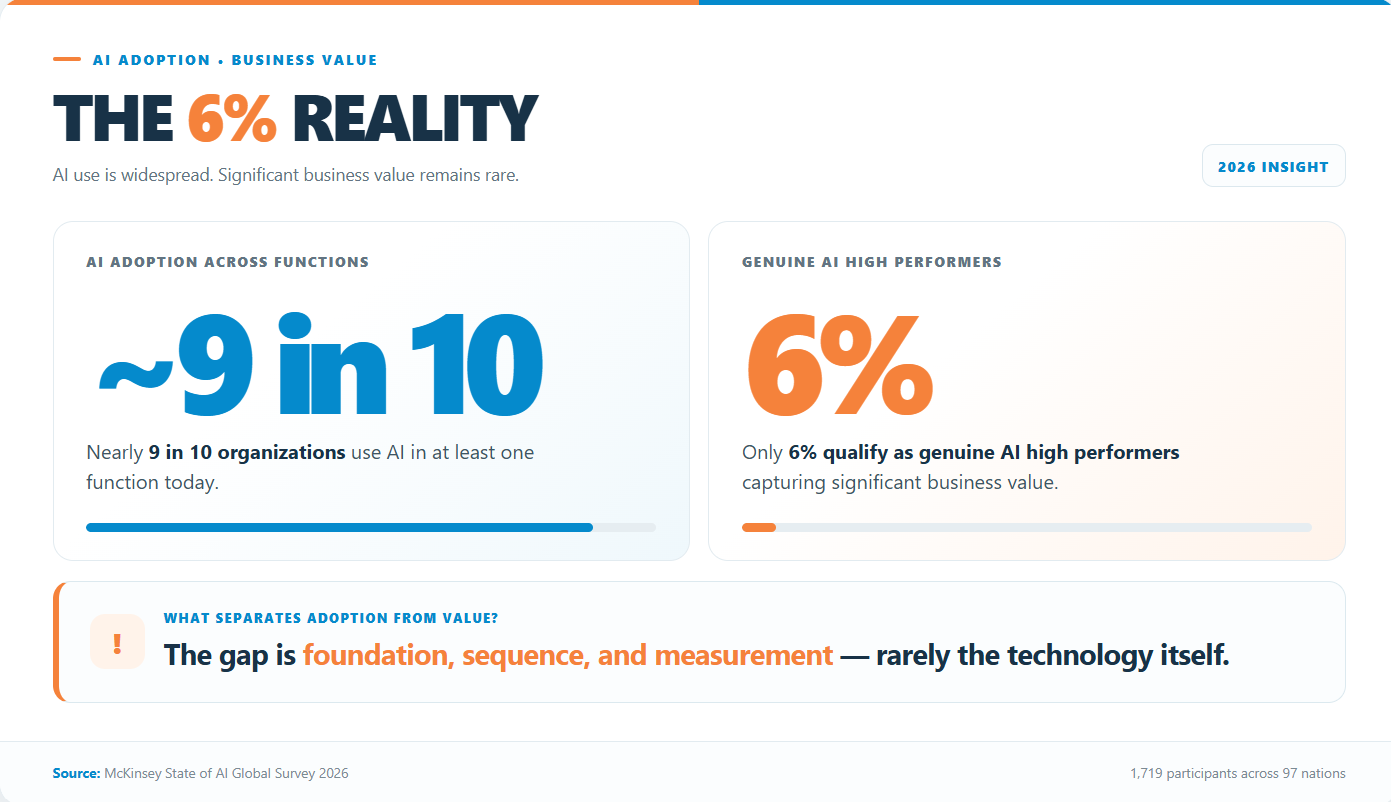
The organizations McKinsey identifies as genuine AI high performers share one characteristic: they built and governed all four layers deliberately, rather than deploying models and hoping the layers would fill in around them.
AI Architecture Stack
Four connected layers for turning AI capability into governed business outcomes.
OVERSIGHT LAYER
EXECUTION LAYER
INTELLIGENCE LAYER
FOUNDATION LAYER
Enterprise AI that delivers business outcomes is a system built on a data foundation, not a model deployed in isolation.
Frequently Asked Questions
What is the difference between generative AI and agentic AI?
Generative AI creates content and assists decisions in response to a prompt. Agentic AI pursues objectives autonomously across multiple steps and systems, taking real-world actions based on defined goals. The distinction is execution model and autonomy level, not capability ceiling. Both benefit significantly from strong data foundations and well-integrated systems.
Which delivers better business outcomes?
Agentic AI carries higher ROI potential in production, with 88% of early adopters reporting positive returns versus 74% for generative AI (McKinsey State of AI 2026). However, only 23% of organizations experimenting with agentic AI have scaled it successfully into production. The answer depends on organizational readiness, specifically data quality, system integration, and governance maturity, far more than technology choice.
What is agentic AI best suited for in an enterprise context?
Agentic AI delivers measurable value in end-to-end process execution across multiple systems: supply chain exception management, IT incident detection and remediation, financial reconciliation, clinical documentation, and full-cycle sales workflows where human oversight governs boundaries rather than individual steps.
What is generative AI best suited for in an enterprise context?
Generative AI delivers consistent value in content production, knowledge work acceleration, software development support, document review, and customer service assistance. When connected to live data and systems, it also supports contextual decision-making and workflow integration at Layer 2 of the readiness framework.
Can generative AI and agentic AI work together?
Yes. The most effective enterprise AI architectures use generative AI as the intelligence layer and agentic AI as the execution layer, with human oversight and a governed data foundation supporting both. They are complementary, not competing.
What is the biggest risk of moving to agentic AI before the organization is ready?
Agentic AI placed into an environment with weak data foundations, fragmented system integration, or undefined governance will surface those weaknesses at speed and at scale. The failure mode of an autonomous system is larger and harder to reverse than the failure mode of a tool a human is using with oversight. Readiness is a prerequisite, not a parallel workstream.
How long does it take to see ROI from each approach?
Generative AI typically shows measurable productivity returns within one to three months. Agentic AI, when properly architected on a solid foundation, shows significant business outcome returns within six to twelve months. The difference reflects the depth of organizational change each requires.
Closing Thoughts from NewVision Software
The generative AI versus agentic AI debate will sharpen over the next 12 to 18 months as more enterprises move from experimentation to production. Gartner’s forecast of over 40% cancellation rates for current agentic projects by 2027 is a signal worth taking seriously. It says less about agentic AI’s potential than it does about what happens when organizations chase technology capability ahead of organizational readiness.
The businesses capturing the most value from AI share one consistent characteristic: they are deliberate about what they build before they deploy. Clean data. Reliable integrations. Governance that enables AI action within defined boundaries. Measurement frameworks connected to business outcomes from day one.
At NewVision, our AI and analytics practice works with enterprises across every stage of this journey, from building the data and integration foundations that make generative AI adoption genuinely productive, through to designing and governing enterprise agentic AI deployments that deliver outcomes measurable on the P&L. Our approach connects Modernization, Intelligence, and AI as a single strategy rather than sequential projects.
The right question is always: what does our foundation look like today, and what do we need to build next?
READY TO MOVE FROM AI EXPERIMENTATION TO AI OUTCOMES?
NewVision Software helps enterprises assess their AI readiness, design the right architecture, and build toward outcomes that show up on the P&L.