There Are Over 8,000 Programming Languages. Here Is How to Cut Through the Noise.
Every year, the technology industry produces a fresh round of “best programming languages” lists. Most of them tell you Python is popular, JavaScript is everywhere, and Rust is the one developers love but rarely get to use at work.
That is not what this is.
This blog is written for the people making actual technology decisions: CTOs evaluating modernization roadmaps, engineering leaders choosing a stack for a new AI initiative, enterprise architects figuring out what cloud migration actually requires at the language level. If you are a developer picking your first language, there are plenty of other guides for that. If you are deciding what your organization bets on over the next three to five years, read on.
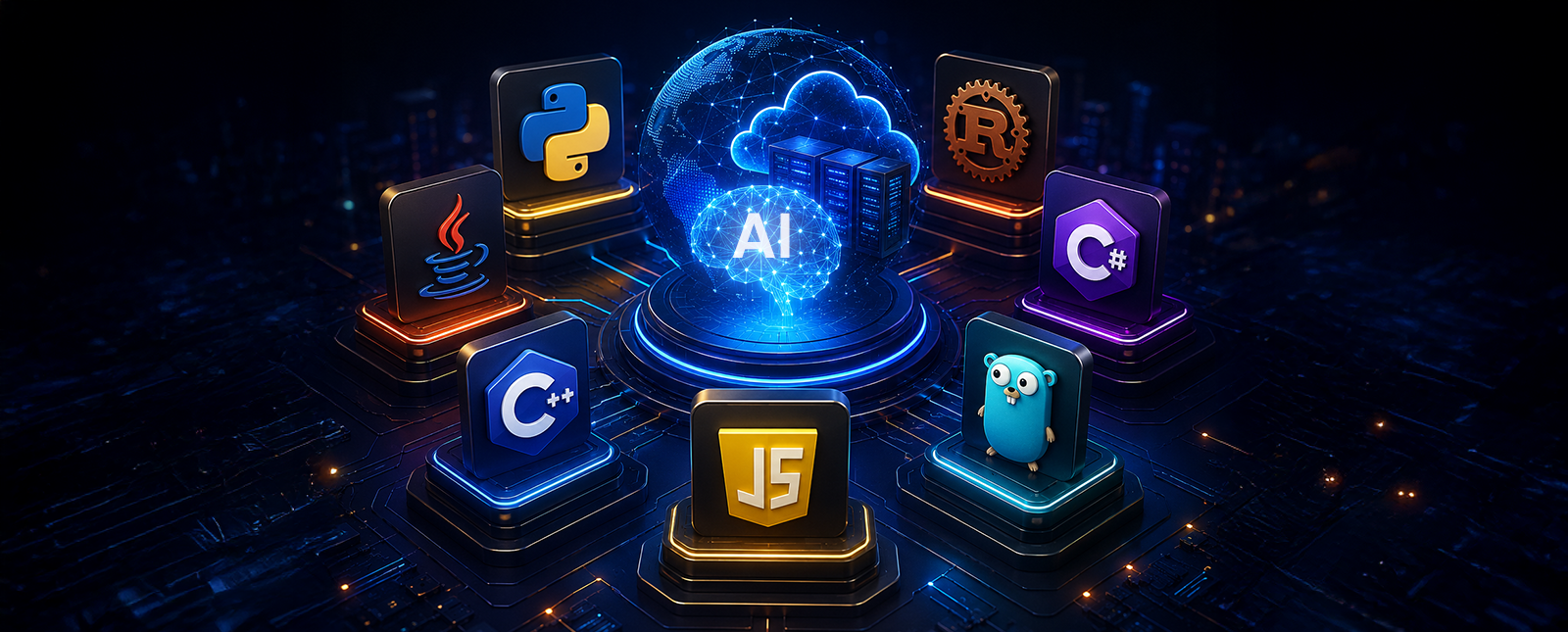
Over 8,000 programming languages have been created since the 1940s. Yet just 6 account for 80% of all newly added software libraries on GitHub in the past 12 months: Python, JavaScript, TypeScript, Java, C++, and C#. (Source: GitHub Octoverse 2025)
What the 2026 Data Is Actually Saying
Before diving into use cases, the numbers deserve a moment. Three independent sources, three consistent signals.
The Stack Overflow Developer Survey 2025, drawing from over 49,000 developers globally, confirmed Python as the most desired language to learn next, with a 7 percentage point increase in adoption driven almost entirely by AI and data science demand. JavaScript, SQL, Java, and Python remained the most widely used overall.
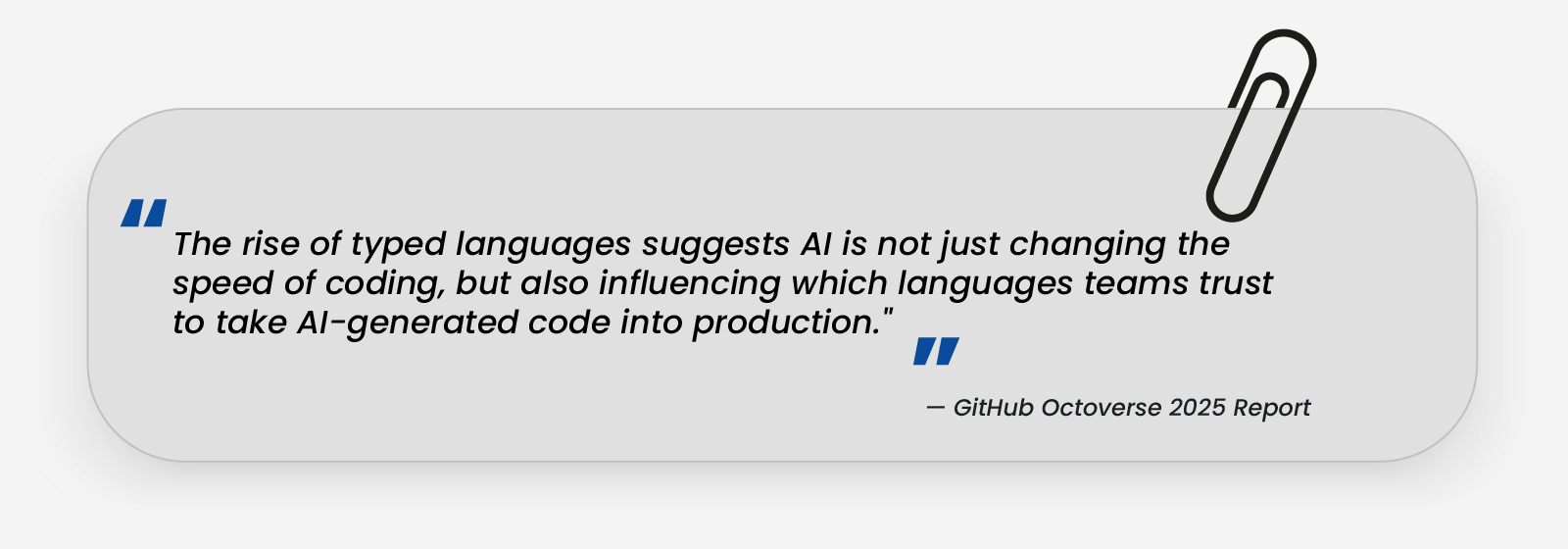
Then came a shift nobody had seen in over a decade. In August 2025, GitHub’s Octoverse report recorded TypeScript overtaking both Python and JavaScript to become the most-used language on GitHub by contributor count, reaching 2.63 million monthly active contributors and a 66% year-over-year surge. GitHub tied this directly to the rise of AI-assisted development, where typed languages handle AI-generated code more reliably in production.
The TIOBE Index for 2026 shows Python at approximately 19.98% market share, nearly 10 points clear of C in second place. And in a result that deserves its own line: C# was named TIOBE’s Programming Language of the Year for 2025, posting the largest year-over-year gain of any major language. That is not an accident. It is the direct result of Microsoft’s sustained investment in the .NET ecosystem.
The pattern across all three sources is consistent: Python owns AI and data. TypeScript is redefining enterprise and full-stack development. .NET and C# are surging on the back of Microsoft’s cloud and AI push. Java holds firm in legacy-heavy enterprise environments. Go is quietly becoming the backbone of cloud-native infrastructure.
AI Programming Languages: The Ecosystem Has Already Decided
If your organization is building anything in the AI space, whether that is a machine learning model, an enterprise AI strategy, an LLM-powered product, a data pipeline, or an intelligent automation layer, your language choices have largely been made for you by the ecosystem.
Python: Non-Negotiable for AI Work
Python is not just popular in AI development. For most practical purposes, it is AI development.
Its 7-point adoption surge in a single year was driven almost entirely by the AI boom. On GitHub, Python remains the clear leader inside AI-tagged repositories, with Jupyter Notebook usage nearly doubling in 2025. That is a direct reflection of how embedded Python is in prototyping, training, and orchestrating AI workloads.
The reason Python dominates is not syntax elegance alone. It is the ecosystem. TensorFlow, PyTorch, scikit-learn, Hugging Face, LangChain, FastAPI: the entire AI tools and development toolchain is Python-native. Switching away from Python in AI development today means leaving behind the most battle-tested library ecosystem in the world.
Best for: Machine learning, deep learning, LLM development, data science, AI automation, backend APIs for AI products.
Python
2026 verdict
Market share
19.98%
YoY growth
+7%
R: When the Work Is Fundamentally Statistical
R occupies a specific lane: statistical modeling, academic research, financial analysis, and reproducible data science. While Python handles the engineering side of AI, R is the preferred tool when the work is more analytical than computational. It has staged a notable comeback in the TIOBE Index in 2026, re-entering the top 10. For organizations running serious data analytics functions, R and Python work alongside each other rather than compete.
Best for: Statistical modeling, research analytics, financial data science, bioinformatics.
Julia: The High-Performance Option Worth Watching
Julia is the language data scientists reach for when Python’s performance ceiling becomes a problem. Designed for high-performance numerical computing, it is gaining traction in quantitative finance, scientific computing, and large-scale simulations. If your AI strategy involves heavy numerical computation where speed is non-negotiable, Julia belongs in your evaluation.
Best for: High-performance AI, numerical computing, scientific simulations, quantitative finance.
What is your AI use case?
Cloud Programming Languages: Built for Systems That Cannot Break
Cloud and DevOps transformation has its own demands: concurrency, microservices, containerization, and APIs handling millions of requests without degrading. The languages winning here are designed for systems that need to be fast, operationally simple, and horizontally scalable.
Go: The Backbone of Cloud-Native Infrastructure
Go was designed by Google to build large-scale distributed systems efficiently. Kubernetes and Docker, the two most critical tools in the cloud and DevOps stack, are both written in Go. That is not a coincidence. It is the industry signalling where its long-term trust sits for infrastructure-level work.
Go’s concurrency model, fast compilation, and small memory footprint make it the natural fit for microservices, container orchestration, and backend infrastructure handling millions of requests per second.
Best for: Microservices, cloud-native backend services, DevOps tooling, container infrastructure, high-throughput APIs.
Azure and .NET: The Enterprise Cloud Stack That Is Surging
This is the combination that deserves its own section, and that most “top programming languages” lists underserve.
85% of Fortune 500 companies now use Azure, making it the dominant enterprise cloud platform by organizational breadth. Azure holds 25% of global cloud infrastructure spend as of Q1 2026, second only to AWS at 30%. And crucially, Azure’s growth is being driven by the very segment NewVision serves: regulated industries, enterprise digital transformation, and Microsoft-ecosystem organizations.
C# and the .NET ecosystem are the natural language layer for Azure workloads. C# was named TIOBE’s Programming Language of the Year for 2025, reflecting continued momentum across enterprise software, cloud services, and Microsoft-centered ecosystems. TIOBE noted it posted the largest year-over-year percentage gain of any major language, reaching 7.39% in January 2026.
What makes .NET particularly relevant for enterprise cloud modernization in 2026 is its maturity across the full stack: ASP.NET Core for high-performance web APIs, .NET MAUI for cross-platform mobile and desktop, Azure Functions for serverless workloads, and deep integration with Azure DevOps, Azure AI Services, and the entire Microsoft intelligent cloud platform.
For organizations already running Microsoft infrastructure, which includes the majority of large enterprises globally, .NET is not just a language preference. It is the path of least resistance to a modern, scalable, AI-ready cloud architecture.
Best for: Azure cloud workloads, enterprise web and API development, serverless functions, cross-platform enterprise applications, Microsoft-ecosystem modernization.
When enterprise cloud and enterprise language move together, that is a stack worth taking seriously.
Sources: Azure market data 2026, TIOBE January 2026
Rust: When Security and Performance Are Both Non-Negotiable
Rust is the most admired programming language in the Stack Overflow Developer Survey 2025, with over 70% of its users wanting to continue working with it. For infrastructure teams handling security-critical code or high-performance networking, Rust delivers C-level performance with the memory safety guarantees C and C++ cannot match. Amazon, Microsoft, and Cloudflare are all running Rust in production infrastructure. Job postings grew 35% year-over-year in 2025. If strengthening cloud security is a priority for your organization, Rust is the language the industry is moving toward at the infrastructure layer.
Best for: Security-critical cloud systems, high-performance networking, cloud security layers, WebAssembly.
| LANGUAGE | SPEED | CONCURRENCY | LEARNING CURVE | PRIMARY CLOUD USE CASE |
| Go | Very Fast | Excellent | Moderate | Microservices, DevOps, APIs |
| .NET / C# | Fast | Good | Moderate | Azure workloads, enterprise APIs |
| Rust | Fastest | Excellent | Steep | Security-critical systems |
| Python | Moderate | Good | Easy | Automation, serverless, AI |
| TypeScript | Fast | Good | Moderate | Cloud apps, full-stack |
| Java | Fast | Good | Moderate | Enterprise cloud services |
Enterprise Programming Languages: Reliability Over Novelty
Enterprise development operates by its own rules: long-term maintainability, type safety, integration with existing systems, strong tooling, and the ability to onboard large engineering teams without chaos. These requirements favor languages with large ecosystems, corporate backing, and decades of production testing at scale. NewVision’s product engineering services are built around exactly these principles.
Java: The Enterprise Standard That Refuses to Retire
Java has powered enterprise software for nearly three decades and remains mission-critical in 2026, despite reaching its lowest-ever TIOBE ranking of fourth place. That is a relative metric, not a story of decline. Large-scale fintech platforms, banking systems, healthcare infrastructure, and ERP software still run heavily on Java. The JVM ecosystem, the maturity of Spring Boot, and the volume of Java talent available globally make it the rational long-term choice for organizations managing complex enterprise systems and product engineering.
Best for: Banking and financial systems, enterprise applications, legacy modernization, large-scale backend services.
C# and .NET: The Full-Stack Enterprise Choice
We covered C# in the cloud section, but its enterprise role extends well beyond Azure workloads. C# is trusted by millions of developers building performance-driven enterprise applications, from internal tools and ERP integrations to customer-facing web platforms and cross-device applications via .NET MAUI. Microsoft’s sustained investment in the ecosystem, including deep integration with AI tools for digital transformation like Azure AI Studio and Copilot Studio, means C# and .NET are not just enterprise-stable. They are increasingly AI-ready.
The TIOBE Language of the Year recognition for 2025 is a signal the enterprise market understands: this is a language gaining momentum, not one coasting on legacy adoption. NewVision’s platform and technology competency practice works extensively within this ecosystem.
Best for: Full-stack enterprise development, Microsoft ecosystem, Azure cloud services, enterprise AI integration, cross-platform applications.
TypeScript: The New Default for Modern Enterprise Development
In August 2025, TypeScript became the most-used language on GitHub, marking the most significant language shift in over a decade. Over 1 million developers adopted it in 2025 alone. The driving force is AI: TypeScript’s strict type system catches errors that AI-generated code introduces, making it measurably more reliable in production. Almost every major frontend framework now scaffolds TypeScript by default.
For enterprise teams building modern web applications, SaaS products, or scalable software products in 2026, TypeScript has become the de facto standard. The AI in DevOps transformation movement is further accelerating its adoption, as typed languages pair naturally with AI-assisted development pipelines.
Best for: Enterprise web applications, SaaS products, full-stack development, AI-assisted development workflows.
Kotlin: Java’s Modern Successor
Kotlin is fully interoperable with Java, making migration gradual rather than disruptive. Google has made it the preferred language for Android development, and it is increasingly used for server-side enterprise applications. For teams looking to modernize Java-heavy systems without a full rewrite, Kotlin is the pragmatic path forward, and a natural fit within product and platform transformation engagements.
Best for: Android development, Java modernization, server-side enterprise systems.
LARGE-SCALE LEGACY SYSTEMS
MICROSOFT / AZURE ECOSYSTEM
MODERN FULL-STACK / AI-READY
JAVA MODERNIZATION / ANDROID
Choosing the Right Language for Your Stage of Transformation
At NewVision Software, we see organizations across three distinct stages of their digital transformation journey. The language decisions that make sense at each stage are fundamentally different, and choosing the wrong one for your current stage is one of the most common and most expensive technical mistakes enterprises make.
“The language conversation is almost always happening too late or at the wrong level. The right question is not which language is best in 2026. It is which language fits where you are in your transformation right now, and where you need to be in three years. Those are not always the same answer.”
— Shailesh Erande, Practice Head, NewVision Software
Stage 1: Foundation
What this looks like: Aging on-premise infrastructure, monolithic applications, siloed data, and accumulated technical debt. The priority is stability, integration, and establishing a reliable modern baseline before anything else moves.
Language priorities at this stage:
Java and C# (.NET) are your workhorses. They integrate cleanly with existing enterprise systems, support gradual migration of legacy codebases without full rewrites, and give you access to the largest talent pools for enterprise-scale hiring. Python begins entering the picture for data extraction, reporting automation, and building the early data pipelines that will fuel AI initiatives at later stages.
SQL, often overlooked in these conversations, is mission-critical here. Structured data management underpins every cloud and infrastructure modernization effort.
What to avoid at this stage: Adopting Go or Rust prematurely. These languages shine in greenfield cloud-native environments. In a Foundation stage organization, they introduce unnecessary complexity before the infrastructure is ready to support them. If you are unsure where your organization stands, the GenAI Readiness Canvas is a useful starting point for an honest assessment.
Stage 2: Transformation
What this looks like: Core systems have been stabilized or migrated. The organization is actively moving workloads to Azure and cloud infrastructure, decomposing monoliths into services, and beginning to deploy enterprise AI and cloud strategy use cases in production.
Language priorities at this stage:
This is where Go earns its place. As microservices multiply and cloud infrastructure demands increase, Go’s concurrency model makes it significantly easier to manage at scale. .NET and C# deepen their role as Azure workloads multiply, covering Azure Functions, microservices, and API layers cleanly on the .NET stack.
TypeScript becomes the standard for any new customer-facing or internal web product. Python deepens its role from basic automation to full ML pipeline management and AI API development, feeding directly into data analytics and AI capabilities.
What to watch: This is the stage where language sprawl becomes a real risk. Teams running five or six different languages with no coherent stack strategy regularly hit velocity walls. Consolidating around two or three primary languages, typically .NET/C#, TypeScript, and Python for most enterprise environments, is a strategic priority. Intelligent automation initiatives at this stage also benefit enormously from a coherent language strategy, since automation tooling integrates far more cleanly when the underlying stack is consistent.
Stage 3: Innovation
What this looks like: Stable cloud foundation, modern development practices, and AI capabilities actively in production. The focus shifts to competitive differentiation: building proprietary AI products, accelerating development cycles, and scaling engineering capability.
Language priorities at this stage:
Python is the core of every serious AI strategy at this stage, covering model training, fine-tuning, inference pipelines, and agent frameworks. TypeScript handles the product layer: user-facing applications, dashboards, and integrations built on top of AI capabilities. .NET and C# power the enterprise-grade APIs and Azure-native services connecting AI capabilities to business systems.
Rust enters the picture here for performance-critical infrastructure layers, including inference runtimes, real-time data processing, and security-sensitive cloud systems. This is also the stage where AI tools for digital transformation become central to day-to-day engineering, and TypeScript’s strict type system becomes a risk management tool rather than just a preference. AI in DevOps practices mature here as well, with intelligent pipelines replacing manual release and deployment workflows.
Quick Reference: All Major Programming Languages by Domain
Overall popularity (TIOBE May 2026): Python, C, Java, C++, C#
Fastest growing (2025 to 2026): TypeScript (+66% GitHub YoY), C# (.NET, TIOBE Language of the Year 2025), Python (+7% Stack Overflow)
By use case:
- AI and machine learning: Python, R, Julia
- Cloud and DevOps infrastructure: Go, Rust, .NET/C#, Python
- Enterprise and full-stack product engineering: Java, C# (.NET), TypeScript, Kotlin
- Azure ecosystem: C# (.NET), TypeScript, Python
- Intelligent automation: Python, .NET/C#
- Data and analytics: Python, R, SQL
- Systems and security: Rust, C, C++

What This Means If You Are Making Technology Decisions
There is no single best programming language in 2026. The right language is always a function of the problem you are solving, the team you have, and the stage of transformation your organization is in.
What the data tells you clearly: if you are investing in AI, Python is non-negotiable. If you are building cloud-native infrastructure, Go deserves serious evaluation. If your organization runs on Microsoft and Azure, C# and .NET are not just relevant. They are surging, and Microsoft’s ongoing investment in AI and cloud makes them a safe long-term bet. If you are modernizing enterprise systems, TypeScript is where modern development is heading.
The most resilient technology stacks in 2026 are built on deliberate choices, where each language is doing the job it was designed to do, aligned with where the organization is and where it needs to go. That alignment is the difference between technology decisions that compound into advantage and ones that compound into technical debt. NewVision’s approach to digital transformation is built exactly around helping organizations make that distinction clearly and act on it with confidence.
NAVIGATING YOUR NEXT TECHNOLOGY DECISION?
NewVision Software partners with enterprises across industries to make smarter choices at every stage of digital transformation, from cloud and DevOps and AI strategy to full-stack product engineering and intelligent automation.
Data & References
- Stack Overflow Developer Survey 2025: survey.stackoverflow.co/2025/technology
- GitHub Octoverse 2025: github.blog/news-insights/octoverse
- TIOBE Programming Community Index, May 2026: tiobe.com/tiobe-index
- Synergy Research Group, Cloud Market Share Q1 2026: srgresearch.com
- History of Programming Languages: en.wikipedia.org/wiki/History_of_Programming_Languages
- PYPL PopularitY of Programming Language Index, 2026: pypl.github.io