
A practical guide to Enterprise AI strategy, readiness, governance, and adoption in the age of AI transformation
The Enterprise AI Moment
Every major technology shift influences how organizations operate.
The internet transformed how businesses connect with customers. Cloud computing changed how technology is delivered and scaled. Data analytics expanded the ability to make informed decisions across the enterprise.
Enterprise AI is influencing something even broader.
It is reshaping how organizations learn, decide, adapt, and create value.
This is what makes the current wave of Enterprise AI fundamentally different from many previous technology transformations. While earlier shifts focused heavily on systems, infrastructure, and process efficiency, Enterprise AI is increasingly influencing the way knowledge moves across organizations, how decisions are supported, how work is executed, and how innovation occurs at scale.
Over the past few years, artificial intelligence has evolved from an emerging technology topic into one of the most important business conversations of our time. Executive leadership teams across industries are exploring how Enterprise AI can improve customer experiences, accelerate software engineering, enhance operational performance, strengthen decision-making, and unlock entirely new opportunities for growth.
At the same time, a clear pattern is emerging.
The organizations creating the greatest value from Enterprise AI are rarely focused on technology alone.
They are focused on building intelligent organizations.
They are aligning leadership, people, processes, governance, and technology around a shared vision. They are treating Enterprise AI as a long-term organizational capability rather than a collection of isolated initiatives. And they are creating environments where intelligence continuously supports learning, adaptation, and innovation across the business.
This shift in thinking is significant.
The conversation is gradually evolving from exploring what AI can do toward understanding how organizations can evolve because AI exists.
That distinction is shaping the next generation of Enterprise AI strategies.
And it is becoming one of the defining conversations for business leaders navigating the future of work, innovation, and growth.
What Changed in the Enterprise AI Conversation?
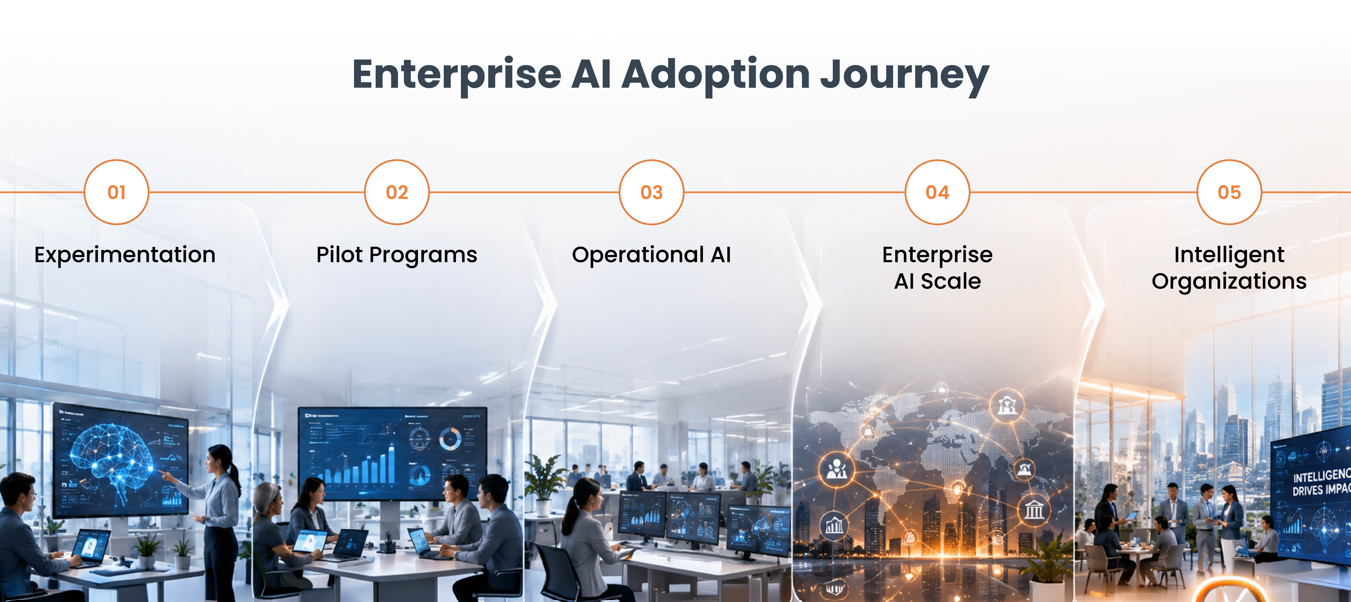
The early stages of AI adoption were largely driven by experimentation.
Organizations explored machine learning models, predictive analytics, recommendation engines, conversational assistants, and automation initiatives to better understand where artificial intelligence could create value.
These efforts delivered important insights and established a foundation for future innovation. Yet many initiatives remained concentrated within specific functions, business units, or pilot programs.
The arrival of Generative AI for Business accelerated the conversation dramatically.
For the first time, AI capabilities became accessible to a much broader audience across the enterprise. Employees gained the ability to generate content, summarize information, write software code, analyze data, access knowledge, and interact with intelligent systems through natural language.
The impact was immediate.
AI moved beyond technology teams and became relevant to marketing leaders, operations teams, software engineers, finance professionals, customer service organizations, and executive leadership teams.
As Enterprise AI capabilities expanded, the questions being asked began to evolve as well.
Initially, many organizations focused on technology-oriented questions.
Which AI platform should we adopt?
Which models should we use?
Which use cases should we prioritize?
Today, enterprise leaders are increasingly asking broader questions.
How can AI improve decision-making across the business?
How can organizational knowledge become more accessible?
How can intelligence flow more effectively between teams and functions?
What capabilities should be developed today to support future opportunities?
How can AI adoption scale across the enterprise while maintaining trust and accountability?
These questions signal an important evolution.
The conversation is becoming less about individual AI tools and more about organizational intelligence.
Organizations are recognizing that AI creates its greatest value when it becomes embedded within the way the enterprise operates rather than existing as a standalone technology initiative.
This is one of the reasons Enterprise AI has become a boardroom discussion.
It is increasingly becoming part of the operating fabric of modern organizations.
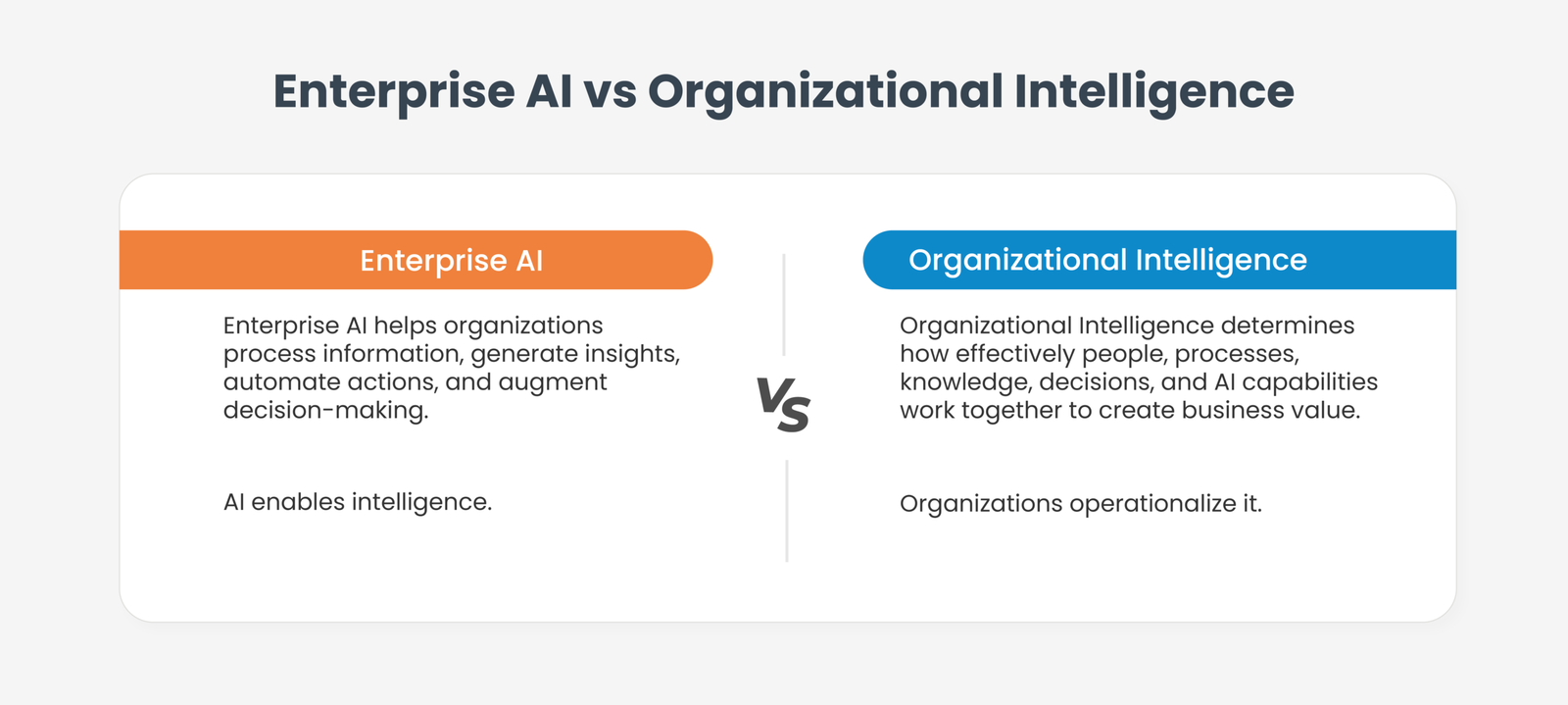
Enterprise AI helps organizations process information, generate insights, automate actions, and augment decision-making.
Organizational Intelligence determines how effectively people, processes, knowledge, decisions, and AI capabilities work together to create business value.
AI enables intelligence.
Organizations operationalize it.
This distinction is increasingly shaping the next generation of Enterprise AI strategies.
What is Enterprise AI?
Enterprise AI refers to the application of artificial intelligence technologies across business functions, workflows, decision-making processes, and customer experiences to create measurable organizational value.
Unlike consumer AI applications that primarily focus on individual productivity, Enterprise AI operates within a broader business context.
It supports strategic objectives.
It interacts with enterprise data.
It influences operational workflows.
It integrates with existing systems.
And it contributes to organizational outcomes.
Enterprise Artificial Intelligence can take many forms.
Some applications focus on predictive capabilities, helping organizations anticipate customer demand, optimize inventory, forecast outcomes, identify opportunities, and improve planning.
Others focus on Generative AI, enabling employees to create content, access knowledge, summarize information, and accelerate complex tasks.
Emerging capabilities such as Agentic AI are introducing new possibilities for coordination, orchestration, and intelligent execution across business processes.
Despite the diversity of technologies, the objective remains remarkably consistent.
Enterprise AI helps organizations make better use of knowledge, data, and intelligence to improve how they operate and create value.
That is why Enterprise AI is increasingly viewed as an enterprise capability rather than simply a technology investment.
Why Enterprise AI is Different
Many people experience AI through consumer applications.
They interact with conversational assistants, recommendation engines, content generation tools, and productivity applications that deliver immediate value at an individual level.
Enterprise AI operates in a very different environment.
Organizations must consider governance, security, compliance, workforce adoption, operational processes, customer expectations, and strategic priorities.
Success depends on much more than deploying a model or implementing a platform.
Enterprise AI must work within the realities of the business.
It must align with existing systems.
It must support decision-making.
It must integrate into workflows.
And it must create measurable value while maintaining trust and accountability.
This is one of the reasons Enterprise AI adoption follows a different path than consumer AI adoption.
Consumer AI focuses on individual productivity.
Enterprise AI focuses on organizational capability.
Consumer AI helps individuals work differently.
Enterprise AI helps organizations operate differently.
That distinction becomes increasingly important as AI moves deeper into enterprise environments.
The most successful Enterprise AI initiatives often focus on enabling people rather than replacing them, strengthening decision-making rather than automating decisions in isolation, and creating intelligence that supports business outcomes rather than technology outcomes.
Ultimately, Enterprise AI is not simply about implementing new technology.
It is about creating stronger connections between people, knowledge, processes, and decisions.
That is where organizations begin moving from AI adoption toward organizational intelligence.
And that is where Enterprise AI begins creating enterprise-wide value.
Enterprise AI is Creating a New Competitive Advantage
Historically, competitive advantage was often associated with scale, intellectual property, operational efficiency, distribution networks, market access, or brand strength.
These factors remain important.
At the same time, Enterprise AI is influencing another dimension of competitive advantage.
Organizational intelligence.
Organizations that can learn faster, access knowledge more effectively, make decisions with greater confidence, and adapt continuously are creating capabilities that extend beyond individual AI applications.
Consider the thousands of decisions that occur every day within a large enterprise.
Decisions related to customers.
Products.
Operations.
Supply chains.
Investments.
Talent.
Risk.
Historically, these decisions relied heavily on human expertise, historical data, and organizational experience.
Enterprise AI expands what is possible.
It provides faster access to knowledge.
It surfaces insights more efficiently.
It helps identify patterns that may otherwise remain difficult to detect.
And it enables decision-makers to evaluate more possibilities in less time.
The organizations creating lasting value from Enterprise AI are not simply deploying more AI solutions.
They are building environments where intelligence becomes more accessible, more connected, and more actionable across the enterprise.
This is one of the reasons Enterprise AI is increasingly being discussed alongside long-term business strategy.
Its impact extends beyond productivity.
It influences adaptability.
It influences innovation.
And increasingly, it influences competitiveness.
Why Enterprise AI has Reached the Boardroom
Enterprise AI discussions increasingly involve CEOs, CIOs, CTOs, Chief Data Officers, business leaders, and boards of directors.
The reason is straightforward.
AI influences far more than technology.
It influences customer experience.
It influences workforce productivity.
It influences operational performance.
It influences innovation.
It influences decision-making.
And it influences long-term competitiveness.
As a result, Enterprise AI is becoming a business conversation as much as a technology conversation.
Leadership teams are evaluating how AI can create sustainable value across the organization while supporting growth, efficiency, resilience, and innovation.
This broader perspective is changing the role AI plays within the enterprise.
Rather than being viewed solely as a technology initiative, Enterprise AI is increasingly becoming part of business strategy, workforce strategy, operating model discussions, and future growth planning.
This shift explains why Enterprise AI continues to gain momentum across industries.
Organizations are recognizing that AI is not simply changing how technology works.
It is helping reshape how organizations work.
And that realization is setting the stage for the next generation of intelligent organizations.
Enterprise AI Use Cases Delivering Value
Enterprise AI is creating value across virtually every business function.
Yet the most successful organizations often focus less on individual use cases and more on the enterprise capabilities AI enables.
Rather than asking where AI can be deployed, they ask how intelligence can improve the way the organization learns, decides, operates, builds, and serves customers.
This perspective often leads to more sustainable outcomes because it connects AI initiatives directly to business capabilities rather than isolated technology projects.
Knowledge Intelligence
Enterprise knowledge has traditionally been distributed across documents, systems, emails, collaboration platforms, meetings, and individual expertise.
As organizations grow, information becomes increasingly abundant. The ability to access the right information at the right moment often becomes more valuable than the information itself.
This is one of the areas where Enterprise AI is creating meaningful impact.
AI-powered enterprise search, knowledge assistants, and Enterprise GenAI solutions are helping employees discover relevant information faster, summarize complex content, identify expertise across the organization, and access institutional knowledge that may otherwise remain difficult to locate.
For example, organizations are increasingly using Enterprise GenAI to make internal policies, procedures, technical documentation, project histories, and knowledge repositories more accessible through conversational interfaces.
This reduces the time spent searching for information and increases the time available for applying it.
Historically, organizations invested heavily in capturing knowledge.
Today, Enterprise AI is helping organizations activate knowledge.
Knowledge that is accessible creates value.
Knowledge that remains difficult to access creates friction.
As AI becomes increasingly integrated into knowledge workflows, organizations are unlocking new levels of productivity, collaboration, learning, and innovation.
In many respects, Enterprise AI is becoming the bridge between organizational knowledge and organizational action.
Decision Intelligence
Every enterprise runs on decisions.
Some are strategic.
Others are operational.
Thousands occur every day across functions, business units, and teams.
Enterprise AI is increasingly supporting decision-making by helping organizations analyze larger volumes of information, identify patterns, evaluate scenarios, and surface insights more efficiently.
This is particularly valuable in environments where decision quality and decision speed directly influence business outcomes.

Forecasting, planning, demand management, financial analysis, customer intelligence, risk evaluation, and resource allocation are all benefiting from AI-enabled decision support.
Importantly, Enterprise AI enhances human judgment rather than replacing it.
The most successful implementations combine human expertise with AI-generated insights to create more informed and confident decision-making.
This combination of human intelligence and artificial intelligence is becoming one of the defining characteristics of modern enterprises.
Operational Intelligence

Operational excellence has long been a priority for enterprise leaders.
Enterprise AI is expanding what operational excellence can mean.
Historically, organizations focused on workflow optimization, process efficiency, and automation.
Today, Enterprise AI introduces a new layer of intelligence into operations.
Systems can identify anomalies, anticipate disruptions, recommend actions, optimize resource allocation, and support dynamic decision-making across business processes.
This evolution helps organizations move beyond static workflows toward more adaptive operating environments.
The result is not simply faster execution.
It is greater responsiveness.
As business conditions continue to evolve, operational intelligence is becoming a valuable capability for organizations seeking to improve agility while maintaining consistency and control.
Engineering Intelligence
Software increasingly shapes how organizations compete, innovate, and create value.
As a result, software engineering has become one of the most visible areas of Enterprise AI adoption.
AI-powered development assistants, code generation tools, testing accelerators, requirements analysis capabilities, and engineering copilots are helping teams improve productivity and accelerate delivery.
Leading technology organizations are integrating AI-powered development assistants into software engineering workflows to support coding, testing, documentation, code reviews, and knowledge sharing activities.
Beyond productivity, Enterprise AI is also influencing how engineering teams collaborate, access expertise, maintain quality standards, and manage increasingly complex technology environments.

This creates opportunities to enhance both engineering effectiveness and engineering experience.
As AI capabilities continue to evolve, software development is becoming one of the strongest examples of how Enterprise AI can augment professional expertise at scale.
Customer Intelligence

Customer expectations continue to evolve.
Organizations are increasingly expected to provide personalized, relevant, and responsive experiences across channels.
Enterprise AI is helping businesses better understand customer behavior, anticipate needs, improve engagement, and deliver more contextual experiences.
Recommendation engines, intelligent service assistants, sentiment analysis, conversational interfaces, and customer insight platforms are enabling organizations to interact with customers in more meaningful ways.
Perhaps most importantly, AI is helping organizations create stronger connections between customer signals and business actions.
This allows enterprises to respond with greater precision while continuously improving customer experiences.
As AI capabilities mature, customer intelligence is becoming an increasingly important differentiator in competitive markets.
Generative AI Is Expanding Enterprise Possibilities
The rise of Enterprise GenAI has significantly expanded the Enterprise AI conversation.
Initially, Generative AI attracted attention because of its ability to create content, generate text, write code, summarize information, and answer questions.
Those capabilities remain valuable.
Yet the broader opportunity is becoming increasingly clear.
Generative AI is evolving from content generation toward knowledge amplification.
Organizations possess vast amounts of information distributed across systems, documents, procedures, applications, policies, and employee expertise.
Enterprise GenAI creates new opportunities to make that knowledge more accessible, more actionable, and more useful.
This is particularly important because knowledge often represents one of the most valuable assets within an enterprise.
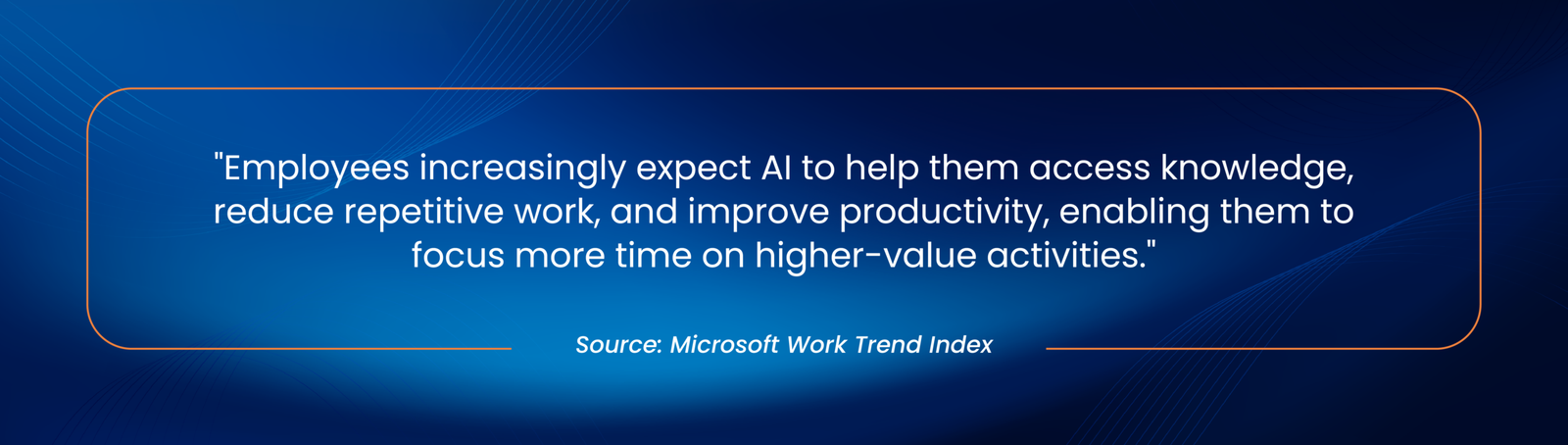
When employees can access relevant insights quickly, decision-making improves, onboarding accelerates, collaboration strengthens, and productivity increases.
As a result, many organizations are beginning to view Generative AI for Business as a knowledge-enablement capability rather than simply a content-generation capability.
This shift is likely to play an important role in the next phase of Enterprise AI adoption.
Agentic AI Introduces a New Operating Model
Generative AI changed how organizations create.
Agentic AI is beginning to influence how organizations coordinate.
This distinction is important.
Generative AI excels at generating content, insights, recommendations, and responses.
Agentic AI extends those capabilities by enabling systems to pursue objectives, coordinate activities, interact with multiple tools, and execute multi-step tasks with increasing levels of autonomy.
For enterprise leaders, the significance lies less in the technology itself and more in the operational possibilities it creates.
Imagine systems that can gather information, evaluate options, coordinate workflows, initiate actions, and continuously adapt based on changing conditions.
These capabilities introduce new opportunities to augment business operations, customer experiences, knowledge work, and decision-making.
While Agentic AI continues to evolve, it represents one of the most significant developments in the Enterprise AI landscape.
Its long-term potential extends beyond productivity gains toward the creation of more intelligent, adaptive, and responsive organizations.
Enterprise AI Is Changing Work Before It Changes Technology
Much of the discussion around Enterprise AI focuses on models, platforms, infrastructure, and emerging capabilities.
Those elements are important.
Yet one of the most significant impacts of Enterprise AI is occurring much closer to everyday work.
The way employees access information is evolving.
The way teams collaborate is evolving.
The way decisions are supported is evolving.
The way knowledge moves across organizations is evolving.
In many enterprises, AI is becoming an intelligence layer that complements existing systems, helping employees access relevant insights, evaluate options, identify opportunities, and execute work more effectively.
This evolution matters because technology adoption alone rarely transforms organizations.
Transformation occurs when the way people work evolves alongside the technology.
Enterprise AI is accelerating that evolution.
Across functions, employees are spending less time searching for information and more time applying it. Knowledge that was previously distributed across documents, systems, and individual expertise is becoming more accessible through intelligent interfaces.
Teams are increasingly able to interact with organizational knowledge through natural language rather than navigating multiple systems and repositories.
This may appear to be a subtle shift.
In practice, it has the potential to influence productivity, collaboration, decision-making, and innovation across the enterprise.
The organizations creating meaningful value from Enterprise AI often recognize this distinction.
They focus not only on AI capabilities, but also on how those capabilities integrate into workflows, business processes, and everyday work.
This is one of the reasons AI readiness extends far beyond technology readiness.
The future of Enterprise AI depends as much on people and processes as it does on platforms and models.
AI Readiness is Becoming a Strategic Capability
As Enterprise AI adoption continues to accelerate, a new realization is emerging across industries.
Successful AI initiatives are rarely defined by technology alone.
They are enabled by readiness.
This is one of the reasons AI Readiness has become an increasingly important topic for enterprise leaders.
Organizations today have access to powerful AI models, cloud platforms, Enterprise AI solutions, and rapidly evolving ecosystems of tools and capabilities.
Technology availability continues to expand at an extraordinary pace.
The differentiator is increasingly becoming organizational readiness.
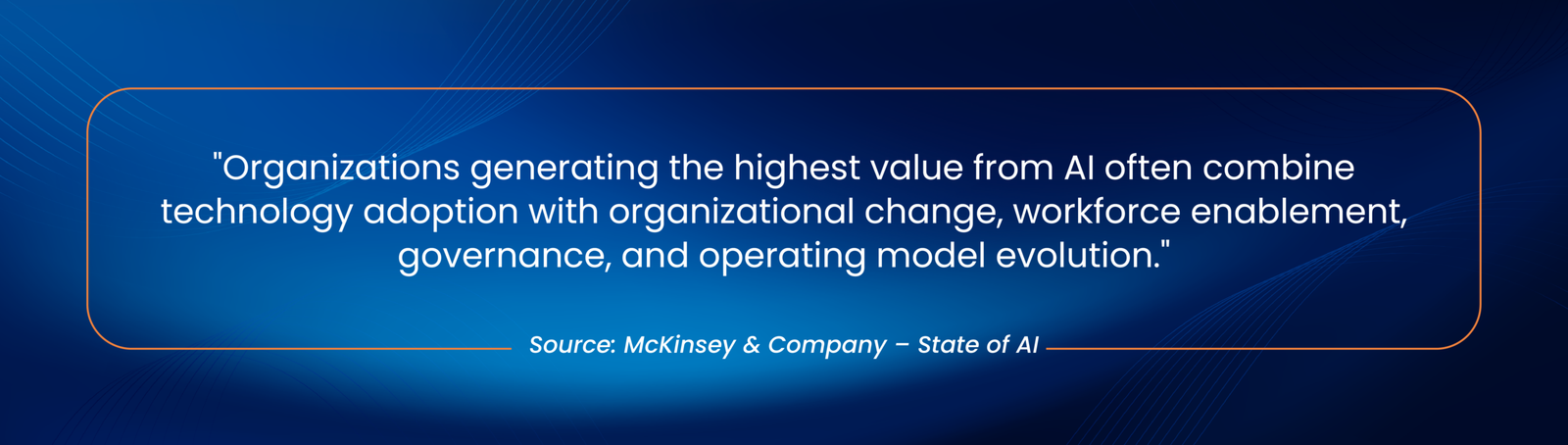
The organizations creating the greatest value from Enterprise AI are often those that prepare their leadership teams, workforce, governance structures, operating models, and business processes to work effectively with AI.
In many respects, AI readiness is becoming a strategic capability.
It influences how quickly organizations can adopt AI.
It influences how effectively they can scale AI.
And it influences how much value they ultimately realize from their investments.
Enterprise AI adoption is not simply a technology journey.
It is an organizational journey.
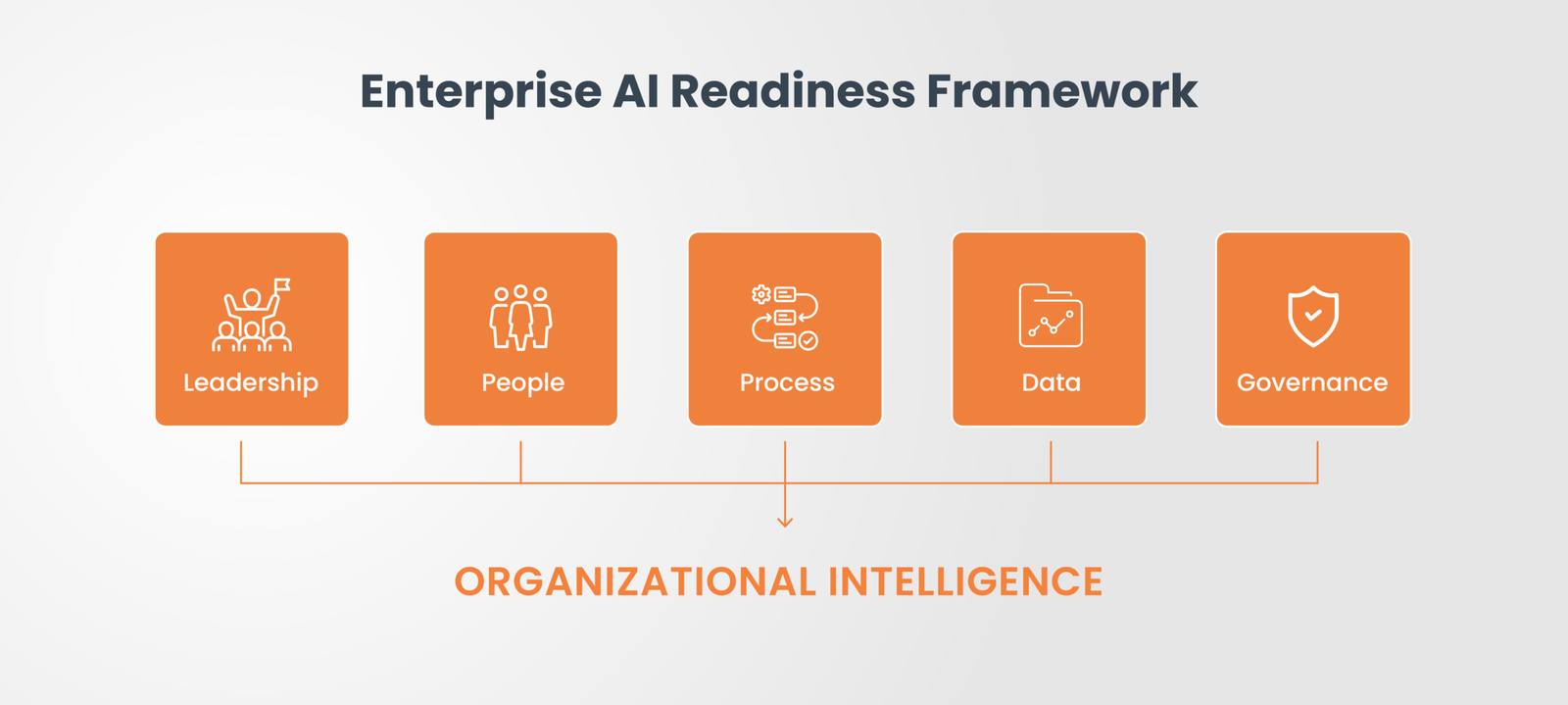
The Five Dimensions of Enterprise AI Readiness
While every organization approaches AI differently, successful Enterprise AI programs often share several foundational characteristics.
Leadership Readiness
Every major business transformation begins with leadership.
Enterprise AI is no exception.
Leadership teams play a critical role in defining vision, setting priorities, allocating resources, establishing governance expectations, and creating alignment across the organization.
Perhaps more importantly, leaders shape how AI is perceived.
When AI is positioned as a strategic capability, adoption often accelerates more effectively than when it is viewed solely as a technology initiative.
Leadership readiness creates clarity.
And clarity creates momentum.
Workforce Readiness
Enterprise AI creates new opportunities for employees.
It enhances access to knowledge.
It supports decision-making.
It accelerates execution.
It expands what teams can accomplish.
Realizing these benefits depends on workforce readiness.
Employees need confidence in how AI works.
They need guidance on where AI can support their work.
They need opportunities to develop new skills and adapt to new ways of working.
Organizations that invest in workforce readiness often create stronger foundations for long-term AI adoption because employees become active participants in the transformation journey.
Process Readiness
AI creates the greatest value when it becomes embedded within business processes.
Organizations frequently discover that introducing AI into existing workflows creates opportunities to rethink how work is performed.
This is where AI begins moving beyond isolated use cases and into operational environments.
Process readiness focuses on understanding where intelligence can enhance decision-making, improve efficiency, accelerate execution, and support better outcomes.
It creates the bridge between AI capability and business value.
Data Readiness
Data remains one of the most important foundations of Enterprise AI.
The quality, accessibility, consistency, and governance of enterprise data directly influence the effectiveness of AI solutions.
As organizations expand AI adoption, data readiness becomes increasingly important.
The objective is not simply to collect more information.
The objective is to ensure that AI systems can access trusted, relevant, and meaningful information that supports enterprise goals.
Strong data foundations often accelerate the journey from experimentation to scale.
Governance Readiness
As AI becomes more integrated into enterprise operations, governance becomes increasingly important.
Governance helps create consistency.
It supports transparency.
It strengthens accountability.
And it helps organizations scale AI responsibly.
Leading organizations increasingly view governance as an enabler of adoption rather than a control mechanism.
Because trust often accelerates scale.
And governance helps establish that trust.
Why AI Readiness Creates Long-Term Advantage
Organizations often begin their Enterprise AI journey by exploring individual use cases.
Over time, a larger opportunity emerges.
The opportunity to build an enterprise-wide capability for intelligence.
This is where readiness becomes particularly important.
Readiness influences how effectively organizations move from experimentation to adoption.
It influences how efficiently AI can be integrated into operations.
And it influences how confidently enterprises can expand AI initiatives across functions and business units.
In many ways, AI readiness creates the foundation upon which Enterprise AI strategies are built.
Technology provides the capability.
Readiness provides the capacity to realize value from that capability.
As Enterprise AI continues evolving, readiness is becoming one of the defining characteristics of organizations that consistently create meaningful outcomes from AI investments.
AI Governance Is Becoming an Accelerator
As Enterprise AI adoption expands, governance is becoming an increasingly important component of long-term success.
Historically, governance was often viewed through the lens of compliance, oversight, and control.
Enterprise AI is helping reshape that perspective.
Leading organizations are increasingly recognizing that governance plays a broader role.
Rather than acting solely as a control mechanism, governance creates the foundation that allows AI initiatives to scale with confidence, consistency, and trust.
This becomes particularly important as AI becomes embedded across customer experiences, operational workflows, software engineering processes, knowledge systems, and decision-making environments.
As adoption expands, organizations naturally seek greater clarity around accountability, transparency, data usage, model performance, security, and responsible AI practices.
Governance helps provide that clarity.
This is one of the reasons AI Governance and Responsible AI have become strategic conversations across industries.
Organizations are increasingly establishing principles, policies, review processes, monitoring capabilities, and accountability structures that help ensure AI aligns with business objectives, regulatory expectations, organizational values, and customer trust.
Viewed through this lens, governance becomes an accelerator.
It creates confidence.
Confidence encourages adoption.
Adoption enables scale.
And scale unlocks value.
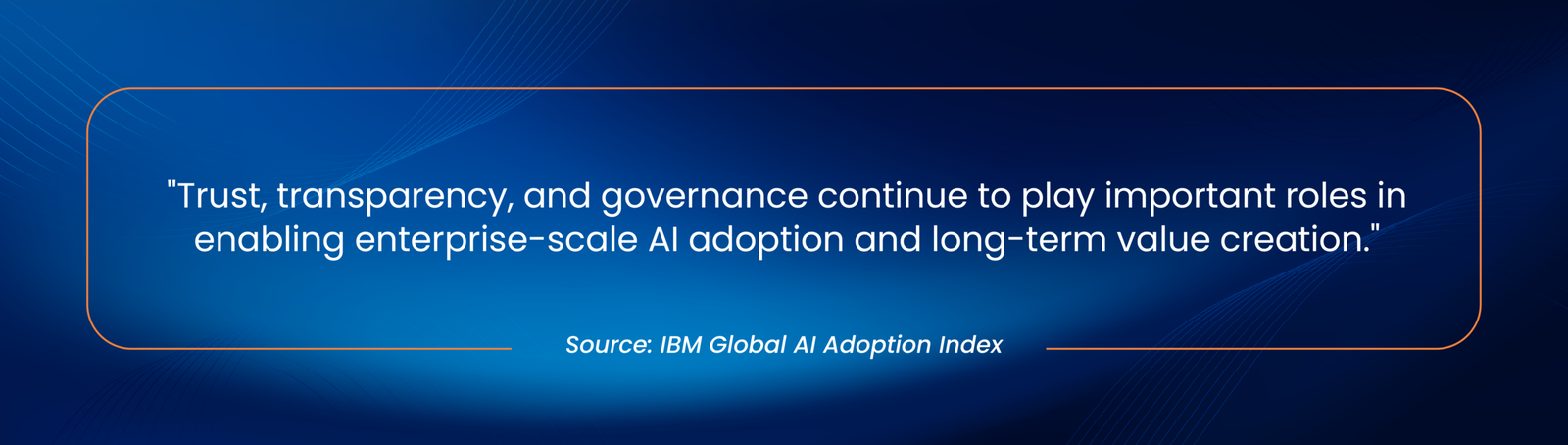
Reference: https://www.ibm.com/reports/ai-adoption
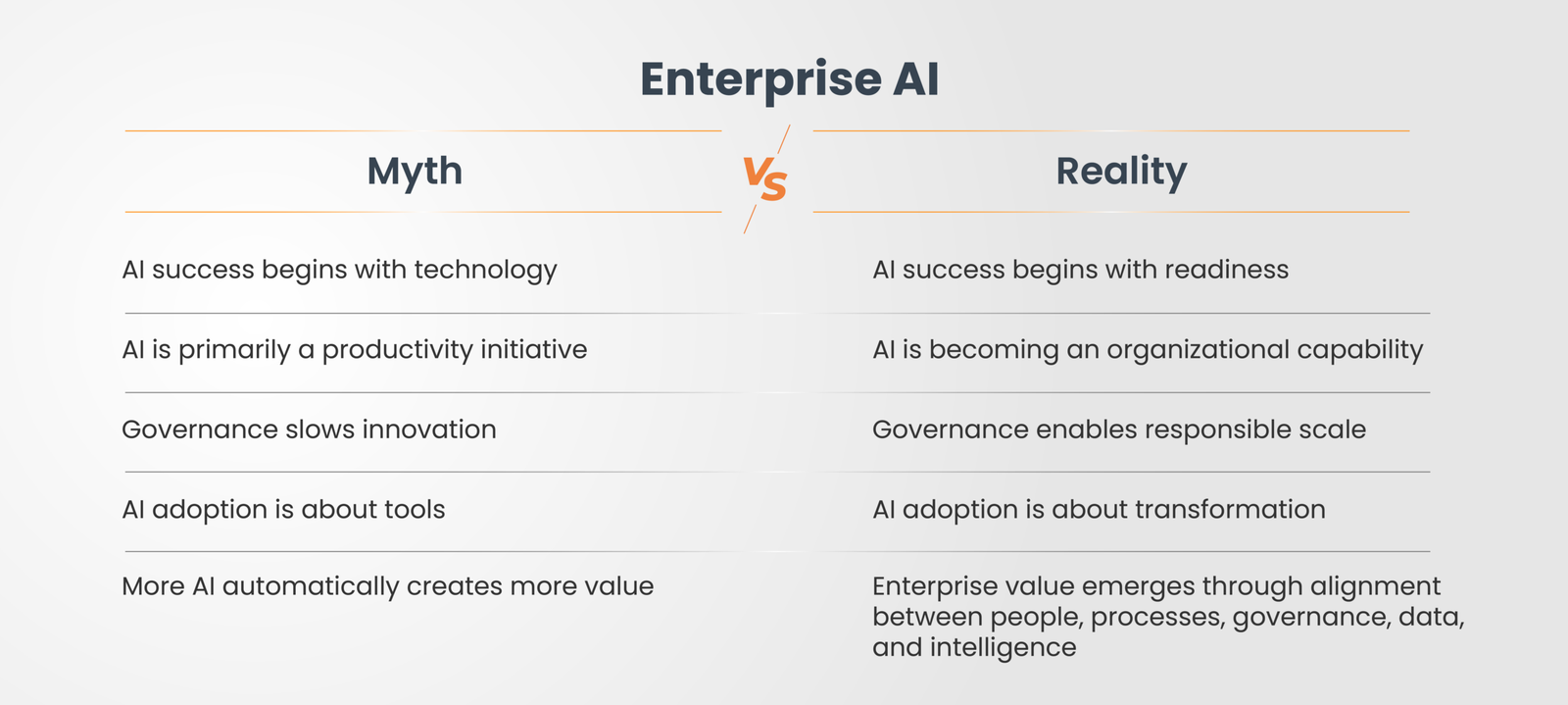
Enterprise AI: Myth vs Reality
The Emerging Enterprise AI Opportunity
As Enterprise AI continues to mature, a broader opportunity is becoming visible.
The conversation is expanding beyond individual use cases.
Beyond productivity improvements.
Beyond isolated deployments.
Organizations are increasingly exploring how AI can become part of the way intelligence flows across the enterprise.
How knowledge is accessed.
How decisions are supported.
How operations adapt.
How innovation accelerates.
This is where Enterprise AI begins evolving from a collection of initiatives into a business capability.
And it is this capability that increasingly differentiates organizations that scale AI successfully from those that remain focused primarily on experimentation.
Enterprise AI Strategy: From Vision to Execution
Enterprise AI is creating opportunities across every area of the business.
Yet realizing those opportunities requires more than enthusiasm, experimentation, or access to technology.
It requires strategy.
An effective Enterprise AI strategy provides clarity around where AI can create value, how initiatives should be prioritized, how governance should be established, and how adoption can scale across the organization.
Importantly, Enterprise AI strategy is not simply a technology roadmap.
It is a business roadmap enabled by intelligence.
Organizations that create meaningful outcomes from AI often focus on several interconnected priorities.
First, they align AI initiatives with business objectives.
Rather than pursuing technology for its own sake, they focus on opportunities that support growth, customer experience, operational performance, innovation, and strategic goals.
Second, they identify use cases capable of generating measurable value.
Successful organizations often begin with targeted initiatives that demonstrate impact while creating momentum for broader adoption.
Third, they invest in readiness.
They develop the leadership capabilities, workforce skills, governance structures, and operating models required to support long-term success.
Finally, they establish mechanisms for measuring outcomes.
As AI adoption expands, organizations increasingly seek visibility into how AI contributes to productivity, efficiency, customer value, decision quality, innovation, and business performance.
Together, these elements help transform Enterprise AI from a collection of projects into a coordinated enterprise capability.
How to Implement AI in an Enterprise
One of the most common questions organizations ask is:
How do you implement AI in an enterprise successfully?
While every organization’s journey is unique, successful Enterprise AI implementation often follows a common pattern.
The journey typically begins with understanding organizational readiness. This includes evaluating leadership alignment, workforce preparedness, governance capabilities, data maturity, technology foundations, and business priorities.
Once readiness is understood, organizations identify high-value use cases that align with strategic objectives and offer measurable business outcomes.
These initiatives create momentum while helping teams gain practical experience with AI capabilities.
The next phase focuses on operational integration.
AI becomes embedded within workflows, processes, systems, and decision-making environments where it can create sustained value.
Governance and Responsible AI practices are established alongside implementation efforts to ensure trust, transparency, accountability, and long-term scalability.
Finally, organizations continuously measure outcomes, refine capabilities, expand successful initiatives, and identify new opportunities for value creation.
Enterprise AI implementation is rarely a one-time project.
It is an ongoing capability-building journey.
And the organizations that approach it as such often realize the greatest long-term benefits.
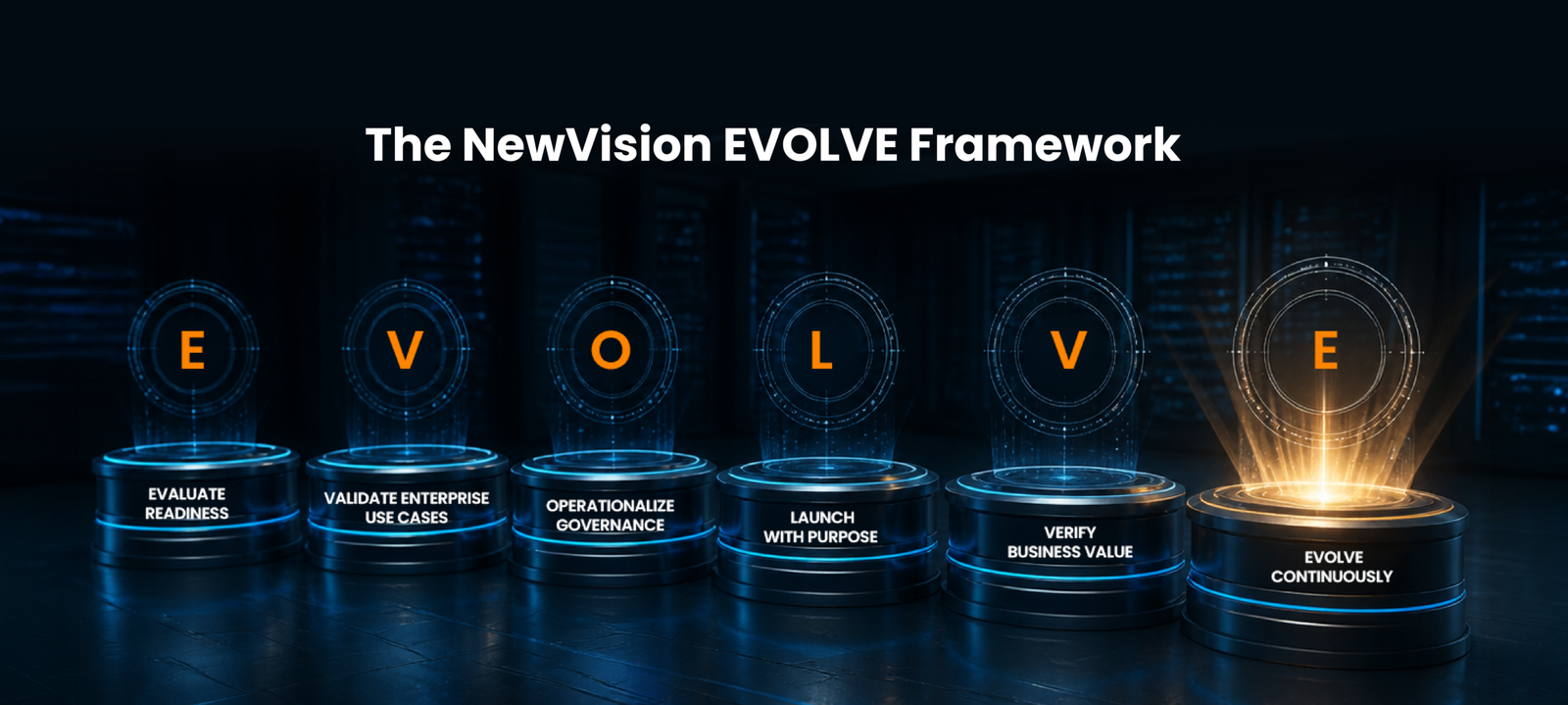
The NewVision EVOLVE Framework for Enterprise AI
As organizations progress through their AI transformation journeys, one question consistently emerges:
How can Enterprise AI move from experimentation to enterprise-wide value?
At NewVision, we believe successful AI adoption requires a balanced approach that combines technology, readiness, governance, business alignment, and continuous evolution.
This belief forms the foundation of the NewVision EVOLVE Framework.
The framework is designed to help organizations build Enterprise AI capabilities that can scale, adapt, and create sustainable value over time.
E – Evaluate Readiness
Every Enterprise AI journey begins with understanding the current state.
Organizations assess leadership alignment, workforce preparedness, data maturity, governance capabilities, technology foundations, and business priorities.
This creates a clear picture of opportunities and establishes a foundation for informed decision-making.
V – Validate Enterprise Use Cases
AI creates the greatest impact when it addresses meaningful business opportunities.
Organizations identify, prioritize, and validate use cases that align with strategic objectives and offer measurable value.
This helps establish momentum while ensuring resources remain focused on high-impact initiatives.
O – Operationalize Governance
As adoption expands, governance becomes increasingly important.
Organizations establish policies, accountability structures, Responsible AI practices, monitoring capabilities, and operational guardrails that support sustainable growth.
Governance helps create trust.
Trust supports adoption.
And adoption supports scale.
L – Launch with Purpose
Validated use cases move into execution.
Organizations deploy solutions, integrate AI into workflows, support workforce adoption, and establish mechanisms for measuring performance and outcomes.
The objective is not simply deployment.
The objective is business value.
V – Verify Business Value
As Enterprise AI capabilities mature, organizations continuously evaluate outcomes.
They assess productivity improvements, customer impact, operational performance, decision quality, innovation acceleration, and strategic value creation.
Measurement creates visibility.
Visibility supports optimization.
And optimization accelerates growth.
E – Evolve Continuously
Enterprise AI is not a destination.
It is an evolving capability.
Organizations continuously refine models, strengthen governance, expand use cases, enhance readiness, and identify new opportunities for innovation.
This continuous evolution helps transform AI adoption into long-term organizational capability.
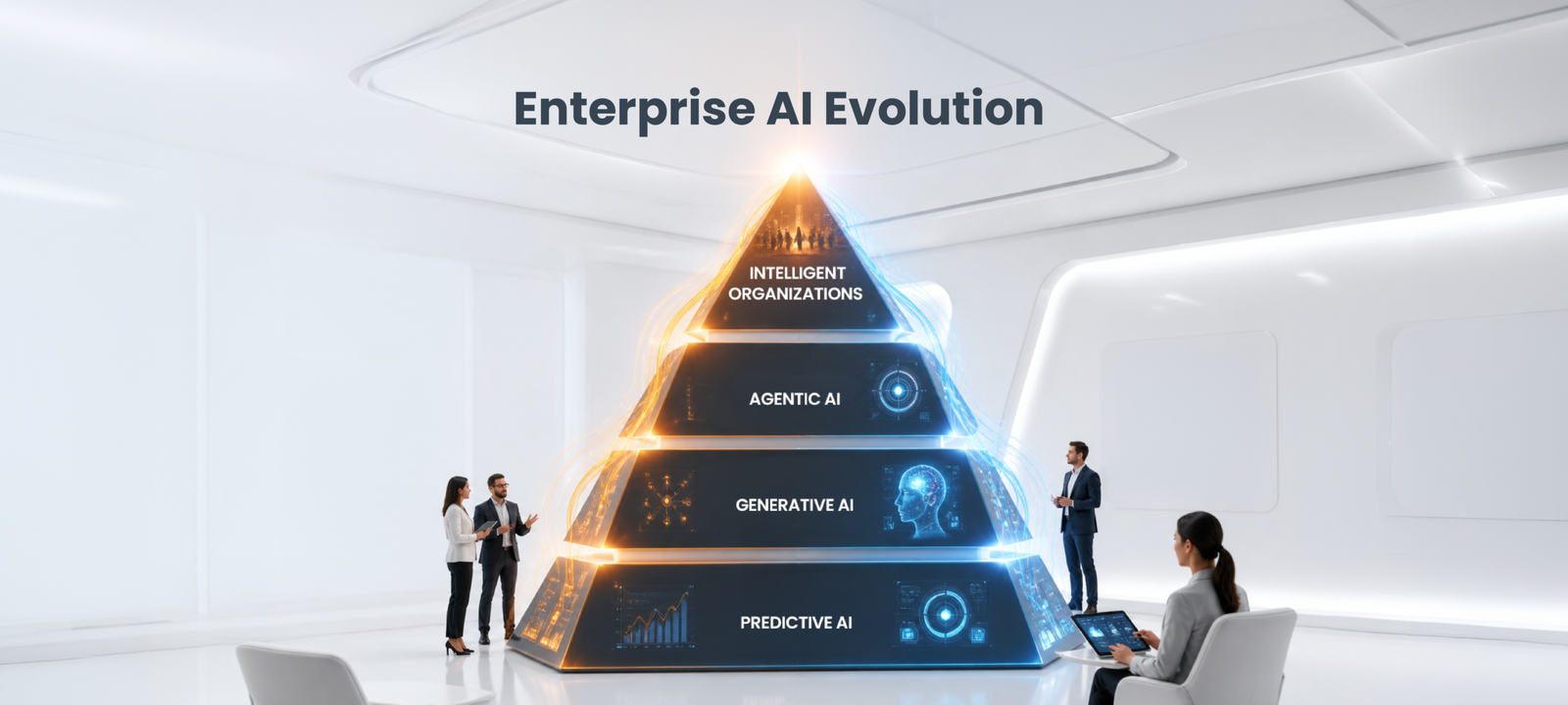
Enterprise AI Evolution: What Comes Next?
Enterprise AI continues to evolve rapidly.
The first phase focused heavily on predictive capabilities.
Organizations used machine learning and analytics to forecast outcomes, identify patterns, and support decision-making.
The next phase introduced Generative AI.
Organizations gained the ability to create content, accelerate knowledge work, enhance productivity, and improve access to information.
Today, attention is increasingly turning toward Agentic AI.
Rather than simply generating outputs, Agentic AI introduces capabilities that can coordinate actions, interact with systems, pursue objectives, and support increasingly sophisticated workflows.
Looking ahead, these developments point toward something even larger.
The emergence of intelligent organizations.
Organizations where knowledge flows more effectively.
Where decisions are supported more intelligently.
Where operations adapt more dynamically.
And where human intelligence and artificial intelligence work together to create new forms of value.
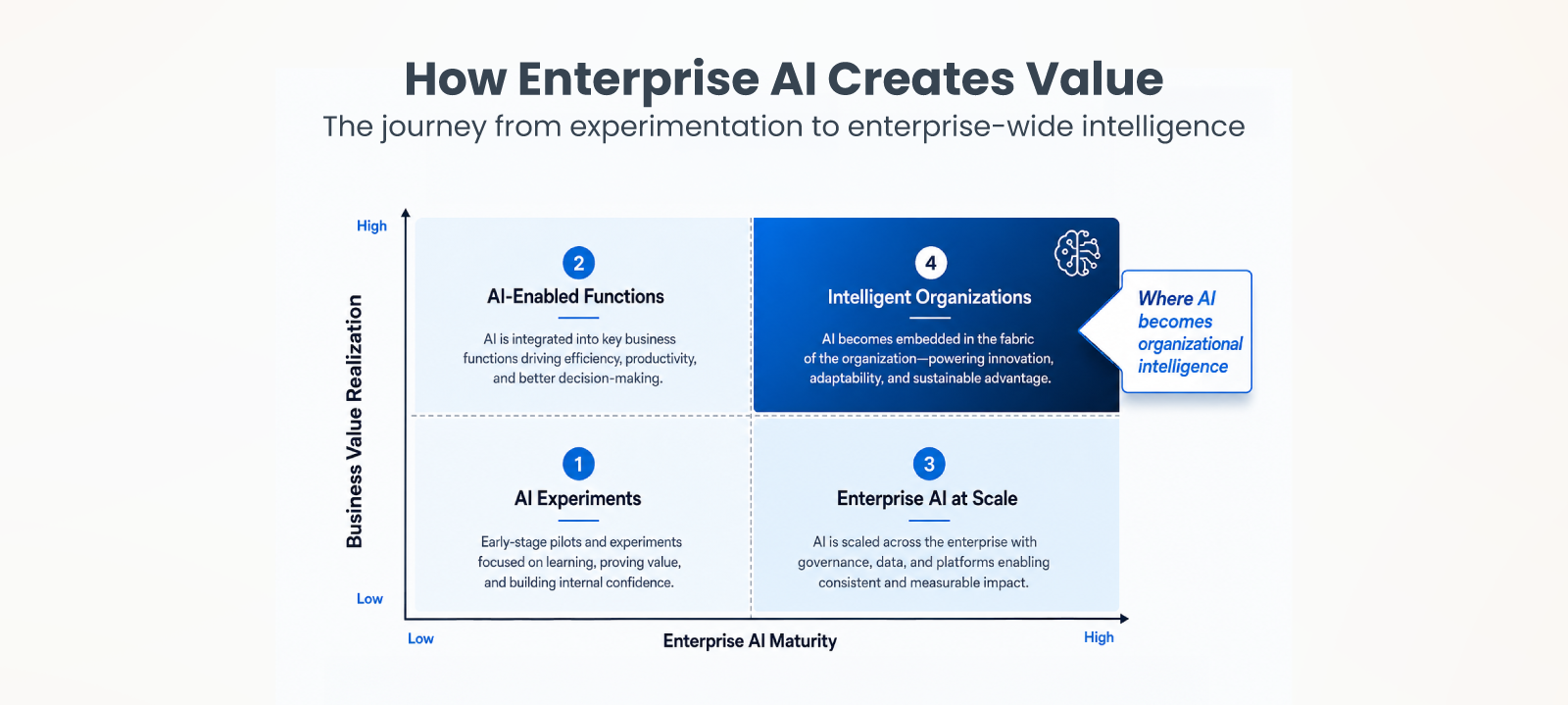
The Path Toward Intelligent Organizations
Enterprise AI is often discussed in terms of technologies, models, platforms, and capabilities.
Those elements are important.
Yet the broader opportunity extends beyond technology.
The organizations creating the greatest value from Enterprise AI are increasingly focused on building environments where intelligence can move more effectively across the enterprise.
They are creating stronger connections between people, knowledge, processes, decisions, and technology.
They are improving how information is accessed.
How decisions are supported.
How work is coordinated.
And how value is created.
This is where Enterprise AI begins influencing organizational intelligence.
And this is where long-term competitive advantage increasingly emerges.
Because while AI capabilities continue to evolve, the ability to learn, adapt, and act intelligently across the enterprise may become one of the most valuable capabilities organizations can build.
References & Further Reading
- McKinsey & Company – The State of AI
https://www.mckinsey.com/capabilities/quantumblack/our-insights/the-state-of-ai
- Microsoft Work Trend Index
https://www.microsoft.com/worklab/work-trend-index
- IBM Global AI Adoption Index
https://www.ibm.com/reports/ai-adoption
- Deloitte State of Generative AI in the Enterprise
https://www2.deloitte.com/us/en/pages/consulting/articles/state-of-generative-ai-in-enterprise.html
- PwC Artificial Intelligence Research and Insights
https://www.pwc.com/gx/en/issues/artificial-intelligence.html
NewVision’s Perspective
At NewVision, we believe the organizations creating the greatest value from Enterprise AI are increasingly focused on building organizational intelligence rather than deploying AI alone.
Technology remains an important enabler.
Yet sustainable value emerges when leadership, people, processes, governance, data, and AI capabilities operate as a connected system.
As Enterprise AI continues evolving, the opportunity extends far beyond productivity improvements or isolated use cases.
It creates the foundation for more intelligent organizations.
Organizations that can learn faster.
Decide with greater confidence.
Adapt more effectively.
And continuously create value in a rapidly evolving world.
The next generation of enterprise leaders may be defined less by how much AI they deploy and more by how effectively they create environments where people, knowledge, decisions, and intelligence work together.
Enterprise AI provides the technology.
Organizational intelligence creates the advantage.
The future belongs to organizations that can combine human intelligence and artificial intelligence to create organizational intelligence at scale.