
When IT strategy comes up in a conversation, it usually begins with planning.
What systems should be modernized, what technologies should be introduced, and how everything aligns with business goals.
Most organizations already have clarity on these aspects. There is a roadmap, a direction, and a set of priorities guiding decisions.
And as this journey unfolds, something interesting starts to take shape.
The impact of IT is rarely defined by what is planned. It becomes visible in how everything comes together across the organization.
That is where IT strategy begins to feel less like a document and more like a way the business moves forward.

What is IT Strategy, really?
At a basic level, IT strategy is about using technology to support business goals.
Over time, it begins to influence much more than that.
It shapes how decisions are made, how systems interact, and how quickly an organization can respond to new opportunities.
A well-formed IT strategy connects business priorities, technology choices, and execution in a way that feels cohesive.
As this connection strengthens, technology becomes part of how the organization operates every day rather than something that runs alongside it.
Why is IT Strategy important today?
The role of IT strategy has expanded as technology has become central to how businesses operate.
Cloud has introduced flexibility.
Data has made decisions more informed.
AI is beginning to add intelligence into everyday processes.
With these shifts, technology actively shapes outcomes across the business.
A thoughtful IT strategy brings clarity to where to invest, how to scale, and how to respond to changing demands.
It also creates consistency, ensuring that systems, teams, and decisions move in the same direction.
How do you develop an effective IT Strategy?
Developing an IT strategy rarely follows a straight line. It evolves as the organization evolves.
It often begins with understanding the current environment. Systems, workflows, and dependencies become clearer when seen together.
From there, direction takes shape. Organizations define what they want to achieve, whether it is improving efficiency, enabling growth, or creating new capabilities.
Technology decisions then begin to align with that direction. Cloud, automation, data platforms, and AI are considered as part of a larger system.
As execution progresses, different initiatives begin to move forward across teams and functions.
This is where the real strength of the strategy becomes visible.
Because everything starts to connect.
What starts to happen during execution
As initiatives move forward, a different layer of understanding begins to emerge.
Systems that looked independent start to reveal dependencies.
Decisions in one area begin to influence outcomes in another.
Priorities evolve as new information becomes available.
This is a natural part of how strategy matures.
A pattern that becomes visible
It often begins with digitizing processes.
Then systems start to connect.
Automation brings speed and consistency.
And over time, intelligence is introduced through data and AI.
Each of these steps adds value.
What makes the difference is how well they come together.
Take something as simple as customer onboarding.
It might begin with digitizing forms.
Then customer data gets integrated across systems.
Workflows become automated.
And eventually, data is used to anticipate customer needs.
Seen individually, each step improves something.
Seen together, they change how the business operates.

Where IT Strategy Creates the Most Value
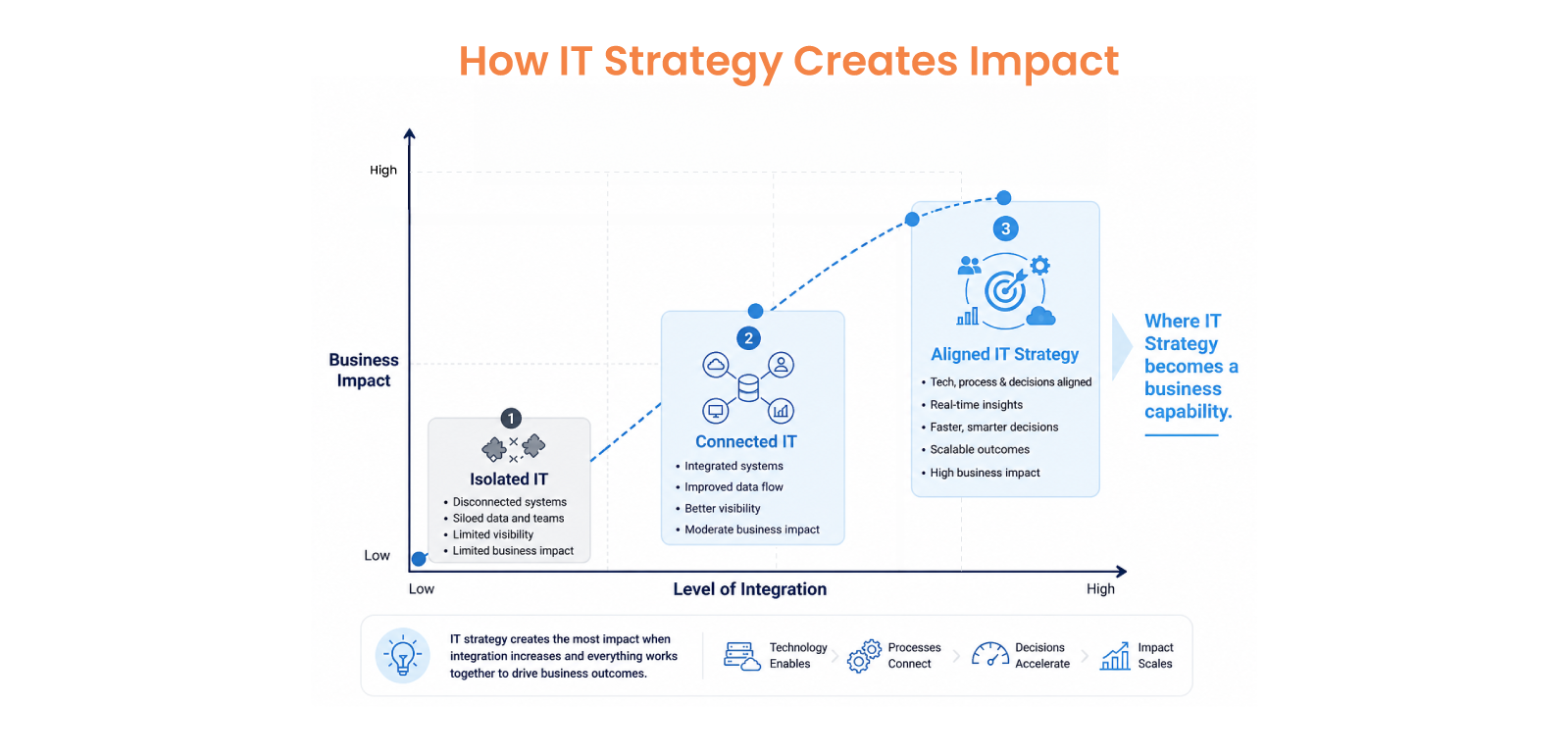
The real value of IT strategy becomes visible when a few things start to align.
Technology begins to support processes more seamlessly.
Processes begin to support faster and better decisions.
Decisions begin to move with clarity and confidence.
This alignment changes how organizations function.
Work flows more smoothly.
Teams operate with greater visibility.
Leaders make decisions with a clearer understanding of impact.
This is where IT strategy starts to feel like a capability rather than a plan.
The Role of Modern IT Strategy
Today, IT strategy is expanding in scope.
It is no longer centered around selecting tools or managing infrastructure. It is about creating a connected environment where everything works together.
Cloud provides flexibility.
Data provides visibility.
Automation provides efficiency.
AI adds intelligence.
Together, these elements shape how organizations operate in a digital-first world.
Bringing It All Together
IT strategy is often described through roadmaps and frameworks.
In practice, it becomes something much more intuitive.
It is about alignment.
Alignment between what the business wants to achieve and how technology supports it.
Alignment between systems and workflows.
Alignment between intent and execution.
When this alignment strengthens, IT strategy becomes part of how the organization moves forward every day.
Looking Ahead
As organizations continue to evolve, IT strategy will play an even more central role.
With cloud, data, and AI becoming more integrated, new possibilities continue to emerge.
Organizations that allow their IT strategy to evolve alongside them tend to move with greater clarity and confidence.
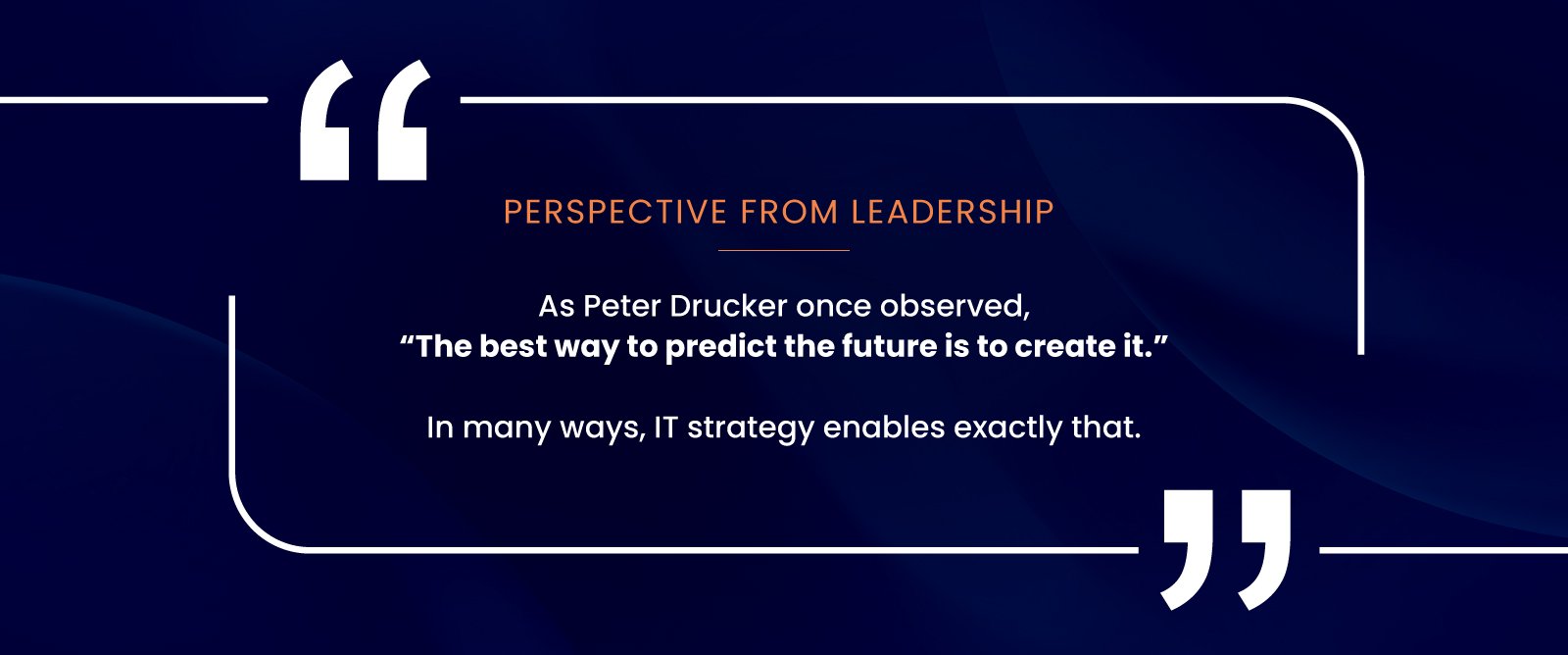
Because ultimately, IT strategy enables progress.